How to Break In New Linen: Reaching the Soft Stage Faster
- Share
- publisher
- KOSSR
- Issue Time
- Oct 25,2026
Summary
New linen is stiff because of residual pectins, loom sizing and a calendered finish, not because the fibre is poor. This guide explains each cause, how to tell garment-washed from loom-state linen, the exact first wash that removes most of the stiffness, a realistic 3 to 5 cycle timeline, weight-based expectations from 110 to 240 gsm, and the habits that speed break-in plus the ones that damage the cloth.
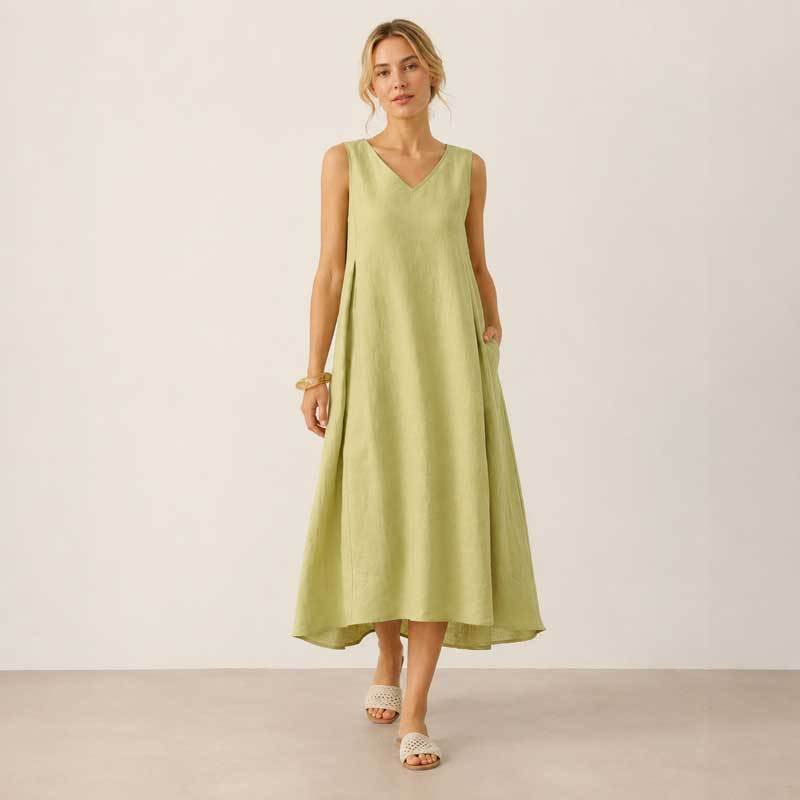
The short answer: new linen is stiff because of what is still in the cloth, not because the fibre is poor. Residual pectins and waxes from the flax stem, the starch sizing applied at the loom, and the crisp pressed finish of loom-state fabric all hold the yarns in a rigid, flat position. Breaking linen in means relaxing those three things with water, mild heat and repeated flexing. In practice that takes three to five wash-and-wear cycles for most 110 to 190 gsm garments, and six to ten cycles for heavy 200 to 240 gsm pieces. Garment-washed linen arrives already past the first and harshest cycle, which is why it feels wearable on day one and only improves from there. This guide explains what stiffness actually is, how to read a product page to know which kind of linen you are buying, the exact first-wash routine that does most of the work, a realistic break-in timeline, and the six habits that genuinely speed the process up, plus the four common ones that damage the fabric instead. If you are building a first linen wardrobe, start with a mid-weight linen dress or shirt rather than the heaviest weave you can find, because mid-weight linen reaches its soft stage fastest. A new linen garment that feels like light cardboard is not a manufacturing fault, and it is not a sign that the fabric is unusually strong. Stiffness is a state, and it comes from three specific things sitting in and around the yarn. The first is natural non-cellulose material. Flax fibres grow bundled in the stem, held together by pectin and covered in a natural wax layer. Retting removes most of it, and spinning removes more, but a proportion always remains on the fibre surface. Those residues act like a thin sizing of their own: they stiffen the surface of each fibre and reduce the slip between neighbouring fibres. When the cloth flexes, the fibres cannot slide past each other easily, so the yarn behaves like a rigid rod rather than a bundle of filaments. The second is added sizing. Most woven linen is sized before weaving. A starch or synthetic size is applied to the warp yarns so they survive the abrasion of the loom healds and reed without breaking. That coating is deliberately stiff, because a floppy yarn will not weave cleanly at speed. Some mills wash it out afterwards; many do not, and a loom-state fabric can carry a noticeable percentage of its own weight in size. This is the layer that makes brand-new linen feel slightly papery and sometimes faintly smooth to the touch, and it is also the layer that makes the first wash water look cloudy. The third is mechanical compaction and finish. Linen is usually calendered, meaning it is pressed between rollers under pressure to flatten the weave and give the surface an even, crisp appearance. Calendering does not change the fibre, but it aligns the yarns into a flat, dense sheet with very little air trapped between them. A flat sheet bends as a unit. A relaxed sheet bends yarn by yarn. The difference in hand feel between a freshly calendered linen shirt and the same shirt after five washes is mostly the difference between those two states. None of this is a quality problem. In fact, a certain firmness at arrival is one of the honest signals that you are looking at real woven flax rather than a blend softened with viscose or finished with a silicone softener. The issue is only that the fabric has not yet been asked to move. Your job in the first month of ownership is to ask it to move, repeatedly, in the right conditions. Cotton and linen are both cellulose, but they are built differently, and that difference explains why a new cotton T-shirt feels soft on day one while a new linen shirt does not. Cotton fibre is a flattened, twisted tube with a relatively disordered internal structure. Linen fibre is a straight polygonal ribbon with a high degree of crystallinity, meaning its cellulose chains are packed in tightly ordered regions. Ordered structures are strong and stiff. They resist bending, and when they do bend they do not spring back quickly. The fibre is also long. Individual flax fibres can run from 25 to 60 centimetres, and in a fine linen yarn they are spun into a continuous, low-twist thread. Long, low-twist yarn gives linen its characteristic dry handle and its sheen, but it also means a single yarn crosses many weave intersections, and every one of those intersections is a hinge point where the yarn must bend. In new cloth those hinges are tight. Softening is the gradual loosening of exactly those points. Two mechanisms drive that loosening. The first is hydration and drying. Water swells the fibre, pushes the cellulose chains slightly apart, and lets the yarn relax into a new, less stressed geometry. When the cloth dries under no tension, it keeps some of that new geometry. Each wet-dry cycle therefore leaves the fabric marginally softer and more supple than the last. The second is mechanical flexing. Bending, crumpling and friction break the weak hydrogen bonds that hold fibres in their calendered alignment and allow individual fibres to migrate slightly within the yarn. This is why the elbows of a linen shirt, the seat of linen trousers and the hem of a linen dress always soften first. They are the places the cloth has been asked to bend the most. That combination, water plus flexing, is the whole principle of breaking linen in. Everything else in this guide is a way of delivering those two things efficiently without causing the damage that heat, harsh chemistry or tension can do. If you want the broader washing context first, the step-by-step linen washing guide covers temperatures, detergents and drying in more detail than this article needs. Before you plan a break-in routine, establish what you are starting from. Two linen shirts can look identical on a screen and behave completely differently in the first month, because one is loom-state and one has been garment washed. The difference is not marketing language, it is a real process step with a measurable effect on hand feel and on how much shrinkage is left in the cloth. Garment-washed linen has been washed, usually in a large drum with softener-free detergent and sometimes with enzymes or stones, after the garment was cut and sewn. That single industrial cycle removes most of the loom sizing, relaxes the weave and takes out the bulk of the shrinkage the fabric would otherwise deliver in your own machine. What is left is a fabric that feels soft, slightly textured and already settled. Loom-state linen, sometimes sold as "crisp" or "classic" linen, has not been through that step. It arrives flat, smooth and firm, with its full shrink potential and its full sizing load still present. Check the product page for the words "garment washed", "pre-washed", "washed linen" or a stated shrinkage figure, and check the care label when the parcel arrives. Every KOSSR garment is made from 100 percent European Flax and is garment washed before it ships, with fabric weights listed between 110 and 240 gsm. That means the break-in curve is shorter than the table above suggests for loom-state cloth, but it is not zero. Garment washing removes the worst of the stiffness, not all of it, and the difference between a garment-washed linen dress on wash one and on wash twenty is still real and still worth having. If you want a deeper comparison of the two fabric states, including how each behaves in the dryer and how each ages over a year, the article on washed linen versus regular linen covers it in detail. Softening is not linear. Most of the change happens early, then the curve flattens and the fabric continues to improve slowly for years. The table below describes what to expect from a garment-washed mid-weight linen piece at 150 to 190 gsm, washed and worn in normal rotation. Heavier fabric sits one to two stages behind at every point. Lighter fabric at 110 to 140 gsm moves faster through the early stages but plateaus at a thinner, crisper hand. Two practical consequences follow. First, do not judge a linen garment on the first wearing. Judge it on the fifth. Second, do not try to compress the whole timeline into one aggressive wash. A single hot wash with heavy detergent will not deliver the soft stage, it will only fatigue the seams and fade the colour unevenly. The soft stage is cumulative, and the cheapest way to reach it is ordinary rotation. If you only do one thing well, do the first wash well. This is the cycle that strips the remaining loom sizing, delivers the residual shrinkage, and sets the fabric's new relaxed geometry. Follow the sequence below in order. It is written for a front-loading machine; a top-loader needs the same temperatures and the same extra rinse, with the garment placed in a mesh bag to reduce agitation. If you want an optional mechanical boost, give the garment 10 to 15 minutes in a tumble dryer on low heat while it is still damp, then take it out and finish drying flat or hung. That short tumble flexes the cloth hundreds of times while it is warm and pliable, which is the fastest legitimate shortcut available at home. Past 15 minutes the benefit stops and the risk of over-drying the seams, setting creases and shrinking the hems starts to climb. For linen that has already been washed a few times and still feels tight, the specific question of how to relax the fibre further is covered in the FAQ on how to soften linen fabric, which goes deeper into soaking, steaming and repeated washing than this routine needs to. Beyond the first wash, the fastest route to soft linen is not a product. It is frequency and movement. These six habits are listed in order of effect, and all of them work with the fibre rather than against it. One habit that does not work, despite being widely repeated, is freezing linen to soften it. Cold does not plasticise cellulose, and a night in the freezer changes nothing about the hand feel once the garment returns to room temperature. The same applies to soaking linen in milk, vinegar or salt water. None of these reach the fibre structure that causes stiffness, and some of them leave residues that attract insects or discolour the cloth. The failure modes here are well documented and all of them are avoidable. Each one either coats the fibre, damages it, or sets a crease that no later wash will remove. The overall principle is simple: linen responds to water, gentle heat and movement, and it does not respond well to chemistry or force. Anything that feels like a shortcut by being more aggressive is almost certainly damaging the cloth rather than softening it. Fabric weight in grams per square metre is the single best predictor of how long break-in will take. Heavier cloth has more fibre mass per square metre, more yarn crossings per centimetre, and more material to relax. It also has a bigger payoff when it finally softens, because heavy linen at 200 to 240 gsm drapes in a way light linen cannot. Weight also decides where stiffness shows first. On light linen it shows at the collar and cuff, where several layers of fabric meet. On mid-weight linen it shows at the placket, the waistband and the hem. On heavy linen it shows across the whole front panel, which is why a new 220 gsm linen jacket can feel like it is standing away from the chest until it has been worn and steamed a handful of times. If you are buying your first pieces and want the fastest route to the soft stage, a 150 to 190 gsm linen shirt is the most forgiving place to start. The routine is the same for everything, but the place where stiffness is most obvious, and therefore the place to focus your attention, differs by garment type. Not every complaint about stiff linen is a break-in issue. Three other things can masquerade as stiffness, and each has a different answer. The first is fit. A linen shirt that is too narrow across the chest or too short in the body will feel rigid no matter how many times it is washed, because the fabric is under constant tension and cannot drape. Linen has effectively no stretch, so a garment cut too close has nowhere to give. If a piece still feels board-like after five washes, check the shoulder and chest measurement before assuming the fabric is at fault. The second is shrinkage that has already happened. Linen that has been washed hot and dried hard can compact permanently, and the resulting fabric feels stiff and dense rather than soft. The article on whether linen shrinks after washing explains how much movement is normal and when a garment has gone past the point of recovery. The third is a genuine heavyweight cloth being judged by a lightweight standard. A 240 gsm linen jacket is supposed to feel substantial. It should feel like a jacket, not like a T-shirt. The goal of break-in is not to make heavy linen floppy, it is to let it mould to the body while keeping its structure. Expecting a blazer to feel like a blouse leads to over-washing, which is the one thing that will actually shorten its life. A useful test is the hand-crush test. Take a section of the garment in your fist for five seconds, release it, and watch how it recovers. New linen springs back flat and slightly hard. Broken-in linen holds a soft, irregular crease pattern and feels warmer and more pliable. If it holds a crease but still feels scratchy, the problem is residue rather than structure, and another warm wash with an extra rinse will do more than any amount of wearing. Partly. Wearing linen flexes the cloth and body heat relaxes the yarn, so a garment worn regularly will soften at the elbows, seat and hem without any washing at all. But the loom sizing and residual pectins need water to leave the fibre, so the body of the garment will plateau while the wear points keep improving. Expect wearing alone to deliver perhaps half the softening of a proper wash-and-wear rotation. For garment-washed linen at 140 to 190 gsm, three to five wash-and-wear cycles is the realistic range, with most of the change in the first two. Loom-state linen needs five to ten. Heavy 200 to 240 gsm linen can take ten or more, and a jacket may take two full seasons of occasional wear and steaming. Yes, a little. Garment-washed linen typically moves 2 to 3 percent on the first wash, and loom-state linen can move 5 to 8 percent. Wash at 30 to 40 degrees C and dry flat or hung rather than in a hot dryer, and the movement stays within the tolerance the garment was cut for. Yes. Hand wash in warm water with a small amount of gentle detergent, rinse twice, press the water out in a towel, then scrunch the damp fabric for a minute before drying flat. Repeat every two or three wears. It takes slightly longer than machine washing but reaches the same soft stage, and it is the safer option for heavily embellished or printed pieces. New linen is stiff because the fibre is stiff, the weave is tight and there is still material in the cloth that was put there to help it survive the loom. None of that is a defect, and none of it needs a specialist product to fix. Water, mild warmth, an extra rinse and repeated flexing will take a garment from papery to soft in three to six cycles, and the process cannot be meaningfully rushed without damaging something else. The practical routine is short enough to remember: wash new linen before the first wear at 30 to 40 degrees C with half a dose of liquid detergent and an extra rinse, spin low, shake it out, dry flat or on a wide hanger, and finish with 10 to 15 minutes of low tumble while it is still damp if you want a head start. Then wear it, wash it every two or three wears, and steam rather than press. Skip the softener, skip the bleach, skip the hot dryer, and skip the Internet tricks involving milk, salt or the freezer. Do that, and the garment you own in month six will not resemble the one that arrived in the parcel. That change is the whole reason linen is worth buying, and it is the reason a well-kept linen piece keeps improving for years instead of wearing out. Every KOSSR garment is cut from 100 percent European Flax, garment washed before it ships, and specified at 110 to 240 gsm so you know exactly what you are breaking in. If you want the shortest route to the soft stage, begin with a mid-weight linen dress or linen pants and wear them often. The fabric will do the rest.How to Break In New Linen: Reaching the Soft Stage Faster
What Stiffness in New Linen Actually Is
Why Linen Softens Slowly Compared With Cotton
Read the Label First: Loom-State or Garment-Washed
Characteristic Loom-state linen Garment-washed linen Hand feel when new Firm, flat, slightly papery, cool and smooth Soft, pliable, lightly textured, dry Loom sizing remaining Most of it, often visible as a faint sheen Largely removed in the factory wash Shrinkage left in the cloth Typically 5 to 8 percent on the first wash Typically 2 to 3 percent or less First wash behaviour Noticeable change in size, feel and drape Small change, mainly softening Wash cycles to the soft stage About 5 to 10, depending on weight About 1 to 3 Best suited to Tailored shapes, structured jackets, buyers who want to control the process Dresses, shirts, sets, loungewear, anyone who wants to wear it now The Break-In Timeline: What Changes and When
Stage Cycles What the fabric does What you notice Arrival 0 Factory wash complete, weave relaxed but still set Soft to the touch, slightly crisp at seams and hems, holds a fold First wash 1 Sizing residue fully rinsed out, yarns relax Noticeably softer body, small residual shrinkage, creases press out faster Early break-in 2 to 3 Fibres begin to migrate inside the yarn, hinge points loosen Drape improves, the garment stops standing away from the body Soft stage 4 to 6 Weave opens slightly, surface texture becomes visible Fabric moves with you, holds shape without stiffness, feels cooler in heat Settled 7 to 10 Structure stable, hand feel consistent after each wash No further dramatic change, only gradual polishing at wear points Long term 1 to 3 years Local softening at elbows, seat and hem, colour settles The garment reads as lived-in, which is the point of linen The First Wash That Does Most of the Work
Six Habits That Genuinely Speed Up Break-In
What Not to Do When Breaking In Linen
Weight Changes the Schedule
Weight Typical garments Cycles to soft stage First impression Best approach 110 to 140 gsm Camisoles, tank tops, light blouses, summer dresses 2 to 3 Crisp and slightly papery, very cool to the touch One normal wash, then wear; avoid tumble drying 140 to 190 gsm Shirts, midi dresses, straight trousers, lounge sets 3 to 5 Firm but pliable, holds a fold well First wash plus 10 to 15 minute low tumble, then rotate 190 to 240 gsm Blazers, jackets, wide-leg trousers, heavy shirt dresses 6 to 10 Substantial, almost canvas-like at the seams Wash cold, dry flat, steam rather than press, allow two seasons Garment by Garment: Where Stiffness Shows and How It Goes
When Stiffness Is Not Really About Softness
Frequently Asked Questions
Does linen soften on its own without washing?
How many washes until linen is soft?
Will washing new linen shrink it?
Can I break in linen without a washing machine?
The Honest Summary
Start With a Piece That Softens Fast