How to Care for Printed & Embroidered Linen: Protect the Details
- Share
- publisher
- KOSSR
- Issue Time
- Sep 18,2026
Summary
How to care for printed and embroidered linen: wash at 30C or cooler on a gentle cycle, turn the garment inside out, bag embroidered pieces, skip the tumble dryer, and press print from the reverse at 110-130C so the binder film and the stitching survive.
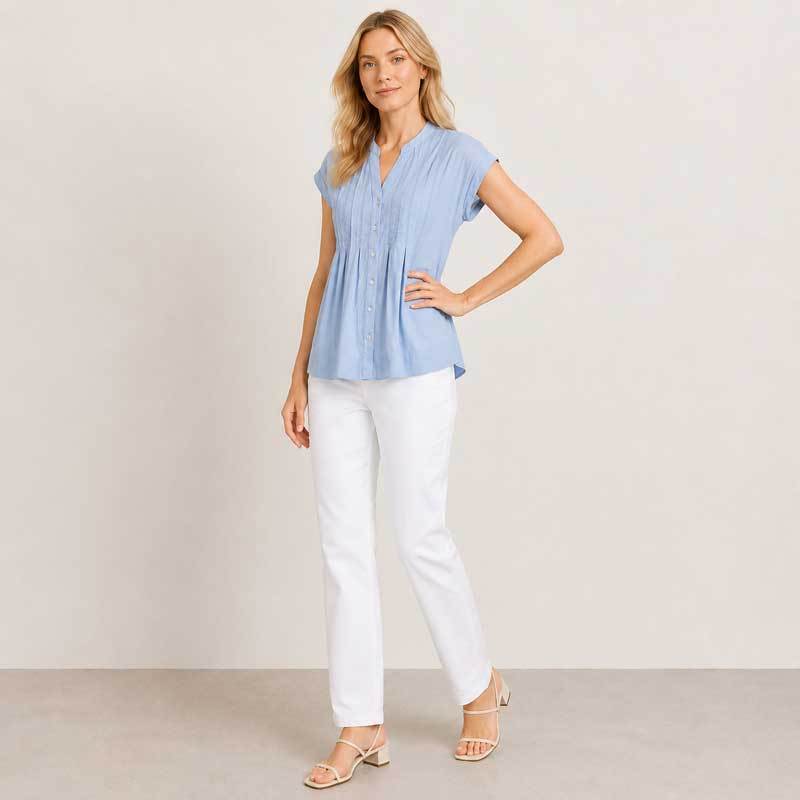
Direct answer: Printed and embroidered linen survives regular wear, not regular heat. Wash both at 30°C (86°F) or cooler on a gentle cycle, turn the garment inside out, put embroidered pieces in a mesh laundry bag, use a pH-neutral liquid detergent with no chlorine bleach and no fabric softener, spin at 400 to 600 rpm, and dry flat or line dry in the shade rather than in a tumble dryer. Iron printed panels from the reverse at 110 to 130°C and press embroidery face-down on a folded towel so the stitches are not flattened. That routine protects the two things that actually fail first: the binder that holds pigment print to the surface of the cloth, and the thread that holds an embroidered motif in place. Garment-washed 100% European Flax linen is already pre-shrunk, so the fabric is rarely the problem; the decoration is. If you want the single rule to remember, it is this: treat decorated linen like the decoration, not like the base cloth. For plain pieces, the general routine in our complete linen washing and maintenance guide is enough; this guide covers what changes once pigment, foil, or thread is added. Written for people who own linen with a printed pattern or an embroidered motif and want to know exactly what temperature, detergent, cycle, drying method, and ironing technique keeps the design intact, plus which shortcuts quietly ruin it. Linen is one of the most wash-tolerant natural fibres in a wardrobe. Flax fibre is a cellulose fibre with high wet strength, which is why linen can be laundered far more aggressively than wool or silk. When something goes wrong on a decorated linen garment, the base cloth is almost never the first casualty. The decoration is. Two different mechanisms are at work, and once you understand them the care rules stop looking arbitrary. Pigment print sits on top of the fibre. In a pigment print, tiny colour particles are glued to the surface of the fabric by a binder, a polymer film that cures onto the cloth. That film is flexible, but it is not the fibre. Repeated heat, high-temperature drying, and mechanical abrasion make the binder progressively stiffer until it cracks along fold lines. You see this as light, web-like lines running through dark areas of a print, usually at the shoulders, elbows, and hip creases, which are exactly the places the fabric folds hardest. Pigment print also sits on the surface, so anything that scrubs the surface, from a stiff brush to a hot tumble cycle, wears the colour away from the peaks of the weave. Reactive and digital prints behave differently. In a reactive print, dye molecules bond chemically with the cellulose fibre itself rather than sitting on a binder film. This is the more colourfast and more durable route, and it is what you want on a linen dress that will be washed weekly. It handles 30°C to 40°C cycles well. Its main vulnerabilities are chlorine bleach, which attacks the dye chemistry, and long ultraviolet exposure, which fades the colour even though the print itself stays physically intact. Embroidery adds a second material with its own shrinkage. Embroidery thread is usually viscose, rayon, polyester, or mercerised cotton, and it was stitched into the linen under tension. When the garment gets wet, the linen swells and then relaxes, and the thread does its own thing. If the thread shrinks more than the base cloth, a dense motif puckers the linen around it. If you tumble dry, the thread can also abrade: the needle holes that the stitching created become the weak points where fibres fray. Metallic and foil-effect threads are the most fragile of all because their coating cracks rather than stretches. The practical conclusion is simple. The number you must control is temperature, and the technique you must control is friction. Everything below is a variation on those two. Most care labels on decorated garments are written for the base fabric, which is why they often say "machine wash warm" on a piece with foil print that should never see a warm machine. Before you choose a cycle, identify which decoration you are dealing with. The table below maps the common decoration types to their weakest point and the safest routine. If you are unsure, assume the most delicate category. The cost of extra caution is a little more time; the cost of the wrong assumption is a permanently cracked motif on a garment you liked enough to buy. For pieces with dense, raised embroidery, the mesh-bag plus hand-wash routine is the safe default. Care instructions for decorated linen reduce to three numbers. Get these right and almost every other decision takes care of itself. Thirty degrees Celsius (86°F) is the ceiling for printed linen, because binder films soften as temperature rises and a warm wash lets the print move and stretch with the fabric in a way it will not do cold. Twenty degrees Celsius (68°F) is the ceiling for anything with metallic or foil thread. Most modern detergents are formulated to work well at 30°C, so you are not trading cleanliness for safety. If a piece is heavily soiled, treat the stain locally first rather than pushing the whole load hotter. Friction damages decoration faster than water does. A gentle or delicate cycle reduces the mechanical action, and a mesh bag removes most of the direct contact between an embroidered motif and the drum or other garments. Spin speed matters too: 400 to 600 rpm removes enough water for quick drying without forcing deep creases into the fabric, and deep creases are where print binder cracks and where embroidery threads are stretched hardest. Use a pH-neutral or mild liquid detergent. Liquid dissolves faster than powder and leaves less residue in the weave. Do not use chlorine bleach on any printed linen: it attacks both the dye and, over time, the cellulose fibre. Oxygen-based bleach is gentler and generally safer on white or pale printed linen, but test it on an inside seam first. Skip fabric softener entirely. On linen it coats the fibre, reduces absorbency, and leaves a film that can dull the appearance of embroidery thread. If you want softness, the honest route is time and wear, plus the pre-washing that garment-washed linen has already had. The rule in one sentence: 30°C, gentle, inside out, mesh bag, pH-neutral liquid, low spin, no bleach, no softener, no dryer for anything with thread or foil. If your question is whether decorated linen can go into a machine at all, the short answer is yes for pigment and reactive prints on garment-washed linen, and no for metallic thread and foil print. Our answer on machine washing linen covers the base fabric question, and the same principles apply once decoration is added. Before the machine starts, three habits prevent most decoration damage. Close buttons and zips, empty pockets, and check for loose threads before washing. A single loose embroidery thread pulled through an entire cycle can unravel a motif that would otherwise have lasted years. If you spot a loose thread, secure it with a tiny knot on the reverse before washing rather than pulling it. Printed linen belongs in the machine, provided the print is pigment or reactive and the garment is not foil finished. Follow this sequence. If you are washing several printed pieces together, keep them in the same colour family for the first few cycles. Dark reactive prints can release a small amount of residual dye in the earliest washes, and pale linen is unforgiving about picking it up. For the wider sequence on plain linen, our complete guide to washing linen clothes walks through the same steps without the decoration constraints. One more point that surprises people: shrinkage. Garment-washed linen has already been shrunk in production, so the base cloth should not move measurably at 30°C. If a decorated piece does tighten up, the culprit is usually the embroidery thread rather than the linen, which is why dense machine embroidery is worth washing cooler and never tumble drying. The mechanics are explained in our answer on linen shrinkage. Hand washing is not automatically gentler than a delicate machine cycle, but it is far gentler when done correctly, because you control the movement. It is the recommended route for metallic thread, antique pieces, densely stitched motifs, and anything with beadwork. The last step is the one people skip, and it is the one that keeps a motif looking new. While the linen is damp, the stitching can still be nudged back into shape. Once it dries, the position is effectively set. If the embroidered area appears puckered after washing, dampen it lightly again with a spray bottle and press it face-down on a towel, then let it dry flat without moving it. If you take one recommendation from this guide and ignore the rest, make it this one: do not tumble dry decorated linen. Heat is what cracks print binder, dulls embroidery thread, and flakes foil. Air drying is not a hardship on linen; the fibre dries quickly and actually benefits from air movement. Hang printed linen inside out so the printed face is not exposed to direct light during drying. Dry embroidered pieces flat or on a padded hanger with the weight distributed, because wet embroidery is heavier than it looks and gravity will pull a motif out of shape if the garment hangs from a narrow point. Full guidance on drying without heat is in our linen drying and care guide. Linen is normally ironed hot, up to 200°C for plain fabric. Decorated linen is a different job, because the decoration has a much lower heat tolerance than the fibre underneath it. Iron from the reverse side at 110 to 130°C, which is roughly the synthetic or low setting on most irons. Never place a hot soleplate directly on a pigment print; the binder will soften and can smear or take on a shine. If you must press the printed face, use a pressing cloth and keep the iron moving. Steam is helpful for linen generally, but a burst of steam straight onto a print can disturb a binder film that is already softened by heat, so steam from the reverse or from a short distance. Press embroidery face-down onto a folded towel. The towel lets the raised stitching sink into the pile instead of being flattened against the ironing board, which is what gives embossed or heavily stitched motifs their dimension. Use a moderate temperature, keep the iron off the metallic thread entirely, and lift rather than slide the iron across the motif. Satin-stitch and dense fills are the most sensitive to flattening. If a piece is only mildly creased, hanging it in a steamy bathroom for ten minutes is often enough, and it is the lowest-risk option of all. More technique, including no-iron approaches, is in our guide on how to remove wrinkles from linen. Ironing in one line: print from the reverse at 110-130°C, embroidery face-down on a towel, metallic thread never touched by the soleplate. Every stain on decorated linen comes with an extra constraint: whatever you use must not damage the print or the thread. Work from the reverse, use cool water, and blot rather than rub. For oil-based marks, a small amount of clear dish soap applied to dry fabric, worked in gently from the reverse, is usually effective before any water is added. For ink and dye transfer, professional cleaning is the safer route on anything valuable. A fuller treatment by stain type is covered in our care library, and the same blot-don't-rub principle applies throughout. How you store a decorated linen piece between seasons determines whether the motif survives to the next year. Linen itself is naturally resistant to moths and mildew, but decoration changes the picture: embroidery thread can attract insects that ignore the base cloth, and print binder can stick to itself or to plastic if stored warm and damp. A cedar block or a lavender sachet is a reasonable low-risk addition for embroidered pieces. Mothballs are not: their vapour is aggressive and can affect both dye and thread over months of closed storage. Our season-by-season approach is covered in how to store linen between seasons. Decorated linen rarely fails all at once. It gives warnings, and acting on them early turns a replacement into a repair. A loose thread is the earliest signal. Secure it with a fine needle from the reverse rather than pulling it, and do not cut it flush. If a small area of stitching has come undone, a matching thread and a few minutes of hand work will stabilise it. If the linen around a dense motif has puckered permanently, the fabric has been pulled out of shape by thread shrinkage; re-dampening and pressing face-down sometimes relaxes it, but once the fibres have set in the puckered position it is difficult to reverse entirely. Fine white hairlines appearing along fold lines mean the binder has begun to crack. At that stage the print will stay put if you stop drying it with heat, keep it out of high-temperature ironing, and rotate fold lines. If the surface has begun to feel chalky or the colour looks abraded at the peaks of the weave, the pigment layer is wearing through and no home treatment will restore it. Prevent it by turning the garment inside out for every wash from the beginning. Foil print and metallic thread are effectively fragile from day one. Once flakes lift, they cannot be re-adhered at home, and they will continue to lift. Handle these pieces as occasion wear, hand wash only, and expect a shorter useful life than a reactive print. That is a fair trade for the finish, as long as you know it going in. When repair stops making sense, the honest move is to repurpose rather than discard. A printed linen shirt with a cracked motif can become sleepwear, a garden shirt, or a cleaning cloth once it is fully worn out. Linen's biodegradability at end of life is part of its sustainability story, as covered in whether linen is biodegradable. If you remember nothing else from this guide, remember the sequence. It takes an extra two minutes and adds years to a decorated garment. Paired with the wider habits of a considered linen wardrobe, this is enough to keep decorated pieces in rotation for many seasons. If you want the version for undecorated pieces, or the routine for structured linen like our linen shirts and linen dresses, start from the plain-fabric guide and layer these decoration rules on top. Yes, if the thread is viscose, rayon, polyester, or cotton. Turn it inside out, use a mesh bag, wash at 30°C on a gentle cycle with low spin, and dry flat in the shade. Metallic and foil threads should be hand washed instead. Reactive and digital prints, which are bonded into the fibre, hold colour well at 30 to 40°C. Pigment prints sit on a surface binder and lose colour where the binder abrades, so low spin and inside-out washing matter more. Chlorine bleach fades both. Wash cool, dry flat rather than hanging, and reshape the motif by hand while the garment is still damp. Avoid the tumble dryer, which is the main cause of thread shrinkage and needle-hole abrasion. No. Softener coats the fibre, reduces linen's natural absorbency, and can leave a film on embroidery thread. Use a mild pH-neutral detergent and let the pre-washed, garment-washed finish do the rest. KOSSR linen is cut from 100% European Flax and garment-washed before it reaches you, so the base cloth is already softened and pre-shrunk. That means the care attention you spend on a garment should go to the print and the stitching, not to fighting the fabric. Explore relaxed linen shirts and linen dresses built for everyday rotation, and keep the routine simple.How to Care for Printed & Embroidered Linen: Protect the Details
Why Print and Embroidery Fail Before the Linen Does
Read the Decoration Type Before You Read the Care Label
Decoration type
How it is attached
What fails first
Safest routine
Pigment print
Binder film on the fabric surface
Binder cracking, surface colour loss
Inside out, 30°C gentle, no dryer, iron reverse only
Reactive or digital print
Dye bonded into the cellulose fibre
Fading from chlorine and UV
30-40°C gentle, no chlorine bleach, dry in shade
Discharge print
Colour removed from the cloth to create the motif
Loss of contrast over time
Cool wash, mild detergent, never scrub
Foil or metallic print
Foil layer adhered to a binder base
Foil flaking and cracking
Hand wash cool or spot clean, never tumble, never iron directly
Viscose or rayon embroidery
Stitched thread under tension
Puckering, thread dulling
Mesh bag, 30°C gentle, dry flat, press face-down
Polyester embroidery
Stitched thread, low absorbency
Colour transfer onto pale linen if hot
Cool wash, dry flat, avoid high heat
Metallic or foil thread
Coated thread stitched into the motif
Coating cracks, snags
Hand wash only, no spin, dry flat away from heat
The Three Numbers That Decide Every Washing Decision
1. Temperature: 30°C, and 20°C for anything metallic
2. Agitation: gentle cycle, mesh bag, low spin
3. Chemistry: pH-neutral liquid, no bleach, no softener
Sort, Turn and Bag: The Three Preparations That Do Most of the Work
How to Machine Wash Printed Linen, Step by Step
How to Hand Wash Embroidered Linen
Drying: Why Heat Is the Real Enemy
Drying method
Printed linen
Embroidered linen
Notes
Line dry in shade
Best
Best
Smooth by hand before hanging; shade protects dye from UV fade
Line dry in direct sun
Acceptable for white only
Acceptable
Sun fades reactive prints; useful for brightening white linen
Flat dry on a towel
Good
Best for heavy motifs
Supports dense embroidery so it does not stretch under its own weight
Hang on a padded hanger
Good for shirts
Good for light motifs
Do not hang a heavy embroidered dress by thin straps
Tumble dry low, 10 minutes
Risky
Not recommended
Only ever as a short de-creasing pass, never to complete drying
Tumble dry full cycle
Never
Never
Principal cause of cracked binder and abraded thread
Ironing Around Print and Embroidery
Printed panels
Embroidered areas
Stain Removal on Decorated Linen: What to Avoid
Storage and Long-Term Protection
Repair, Refresh and Retire: Reading the Warning Signs
Embroidery
Print
Foil and metallic
A Six-Step Care Routine You Can Actually Keep
Frequently Asked Questions
Can I machine wash an embroidered linen shirt?
Will printed linen fade in the wash?
How do I stop embroidery from puckering the fabric?
Can I use fabric softener on decorated linen?
Shop Linen Made to Be Washed and Worn