Linen Gifts Under $100: Where the Value Actually Is
- Share
- publisher
- KOSSR
- Issue Time
- Nov 11,2026
Summary
A value-ranking guide to linen gifts under $100: accessories first, shirts second, dresses last, with the fabric metres, gram weights and sewing minutes behind each price. Includes a category-by-category comparison table, the four cost lines inside a linen price, three gift builds that stay inside the budget, five checks before checkout, and the care routine that decides whether a hundred dollars was well spent.
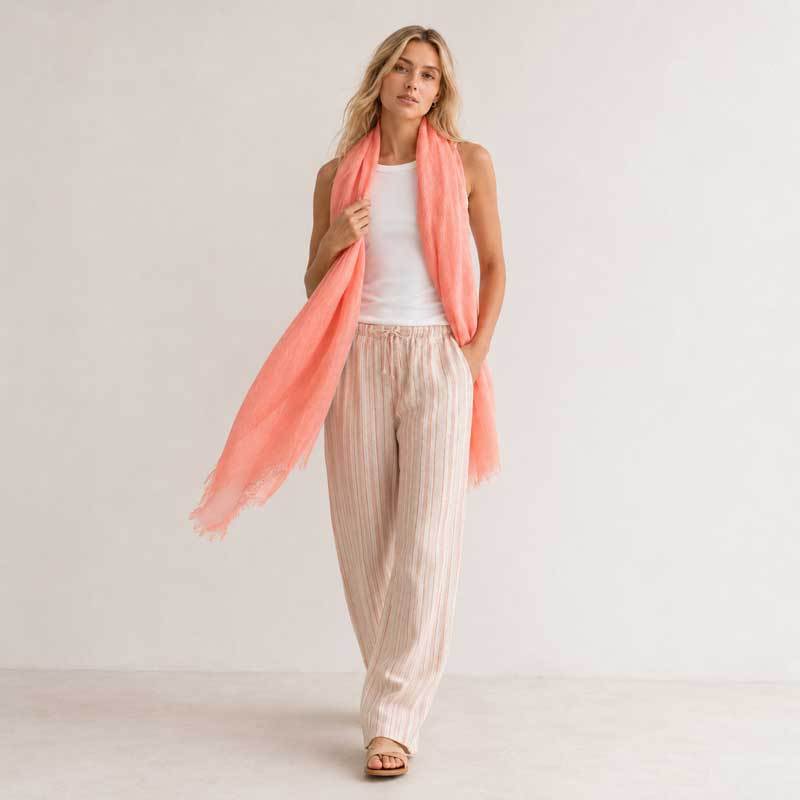
Under $100, linen value ranks accessories first, shirts second, dresses last. A scarf or napkin set carries one to one and a half metres of washed European flax; a hundred-dollar dress carries nearly three metres at a lighter weight. The same money buys less fabric, more seams and more compromise the further you move up the garment. If you have one hundred dollars and want the most linen for the money, buy something small. That is not a consolation prize. It is the direct result of how a garment price is built: cloth is bought by the metre, and a scarf, a napkin set or an apron uses a fraction of the cloth that a dress does while carrying the same fabric quality. Rank the three categories by value density and the order is stable across almost every linen label that sells in this price band. Accessories come first because the cloth-to-labour-to-price ratio is the most favourable and because there is no fit decision to get wrong. Shirts and tops come second because they use about fifty percent more cloth than a scarf but still keep the construction simple. Dresses come last because they use roughly twice the cloth of a shirt, need more seams, more pressing and a longer cutting table, and the price ceiling does not move to accommodate any of that. Value density is the useful way to think about it. Ask what fraction of the price is actual fibre, and what fraction is the cost of turning that fibre into the shape in front of you. Accessories are fibre-heavy. Dresses are process-heavy. Under a fixed hundred-dollar ceiling, the process-heavy item is the one that has to give something up, and what it gives up is usually fabric weight, seam finish, or both. None of this means a dress is a bad gift. It means a dress at this price is a different proposition from a scarf at this price, and the shopper should know which trade they are accepting. The rest of this guide puts numbers on that trade so the decision is deliberate rather than hopeful. Spend under one hundred dollars on cloth, not on construction. Accessories and shirts sell you cloth. A dress at this price sells you a shape and asks you to accept lighter cloth for it. Linen is sold to makers by weight and by metre, and the two are locked together by fabric weight, which is expressed in grams per square metre. A lightweight linen at 110 to 140 gsm is airy, wrinkles quickly and drapes softly. A midweight at 150 to 190 gsm holds a collar and a placket. A heavier 200 to 240 gsm is structured, opaque and used for trousers, jackets and home textiles. The heavier the cloth, the more each metre costs, because you are buying more fibre per metre of the same width. Now put a hundred-dollar ceiling on top of that and the arithmetic becomes visible. A scarf uses roughly one to one and a half metres. A shirt uses one and a half to one and three-quarter metres. A simple dress uses two and a half to three and a quarter metres, and a fuller skirt or a long sleeve pushes it higher. Same fabric, same washing, same workshop, very different cloth bill. Everything else in the cost stack is roughly proportional to the garment too. Cutting time scales with the number of pattern pieces. Sewing time scales with seams, curves, buttonholes and topstitching. Pressing time scales with surface area. Packing and shipping weight scale with grams. So the dress does not just cost more cloth; it costs more of every line item, while the ceiling stays fixed. That is why a hundred-dollar dress is not automatically a worse product than a hundred-dollar scarf. It is a different allocation. The maker has three levers to pull so the dress can exist at that price: use a lighter weight, simplify the construction, or accept a thinner margin. Most labels pull the first two. The shopper who understands this can look at a hundred-dollar dress and read which lever was used, which is exactly what the category sections below do. It also explains a pattern that surprises people in autumn and winter gifting: the same label will offer a heavy 200 gsm scarf and a 140 gsm dress in the same season. The scarf is not the premium item. It is the item where the heavy cloth is affordable, because so little of it is needed. Accessories win on every axis that a fixed budget cares about. They use little cloth, they take little workshop time, they do not need a size, and they are easy to ship. Take a generously sized scarf in a 190 to 240 gsm washed linen: roughly one and a half metres of a heavier, more expensive cloth, cut as a single rectangle, hemmed on four sides, washed, pressed and folded. The making time is in the range of twelve to eighteen minutes. The cloth is the dominant cost, which is precisely what a shopper wants when buying linen. Napkin sets behave the same way. Four napkins at 45 by 45 centimetres use about one metre of 170 to 200 gsm cloth, and the cutting is a straight grid with no curves. Because they are sold as a set, the perceived gift value is higher than the material cost suggests, and there is no fit question anywhere in the transaction. Table runners, placemats, bread bags, aprons and drawstring pouches all sit in the same favourable zone. Small wearables work too, with one caveat. A scarf or a wrap is size-free by design. A belt, a headband or a bucket hat is not, and a hat in particular has a real fit dimension that cannot be guessed from a photograph. If the accessory goes on the body rather than around it, check whether the product page gives a measurement rather than a size label. The one weakness of the accessory category is emotional rather than material: a napkin set can feel small as a standalone gift. The fix is pairing, not upsizing. A scarf plus a care card, or a napkin set plus a note about the wash cycle, costs almost nothing extra and reads as considered. The linen accessories range is the place to see how the pieces scale against each other, because weights sit side by side on one page and the seasonal variants in stock in November are listed per piece. A shirt is the largest garment that still fits comfortably under a hundred dollars without obvious compromise. It uses about one and a half to one and three-quarter metres of cloth, which at 150 to 190 gsm is enough weight to hold a collar stand and a button placket without interfacing tricks. Sewing time lands around thirty-five to forty-five minutes for a clean camp collar or a simple band collar, which is roughly double a scarf and roughly half a dress. That middle position is why shirts are the safest clothing gift in the price band. There is enough cloth to judge quality by hand, enough construction to see whether the maker cared, and enough margin left that the fabric does not have to be downgraded to hit the price. The fit question is what separates a good shirt gift from a bad one, and it is narrower than most shoppers expect. Shoulder width is the only measurement that cannot be altered cheaply, so it is the one to confirm. Chest and waist have tolerance in a relaxed cut; a linen shirt is meant to sit away from the body, and two centimetres of ease either way reads as drape rather than error. Sleeve length can be rolled, which is how most people wear linen anyway. There is a quality test specific to this category that costs nothing. Turn the shirt inside out and look at the side seam and the yoke. A well-made linen shirt has a flat-felled or cleanly overlocked seam, no loose thread tails longer than a centimetre, and a yoke cut on the same grain as the body. Then hold the cloth up to a window: at 150 gsm you should see a soft, even light through the weave, not bright pinpricks in clusters. Pinprick clusters mean thin spots in the yarn, and they will become holes at the elbow within a season or two. At a hundred dollars, a shirt is the category where the price is most likely to be honest. If a shirt at this price feels flimsy, the maker has probably chosen a 120 gsm cloth and priced it as if it were 170. That is readable in the hand in about four seconds. Browse the linen tops and shirts to compare weights side by side, and use the gift sizing guide if the recipient's shoulder measurement is unknown. A dress is the most cloth-hungry item in a linen wardrobe and the least forgiving of a price ceiling. A simple sleeveless or short-sleeve dress uses two and a half to three metres. Add sleeves, a fuller skirt, a lining or a long length and it moves past three. At a hundred dollars, the cloth budget has to absorb all of that, which leaves two realistic routes: use a lighter weight, or simplify the shape until it needs less fabric. Both routes produce a wearable garment. Neither produces the same object as a two-hundred-dollar dress. The lightweight route lands at 110 to 140 gsm, which is cool and pleasant in July but semi-sheer in bright light and prone to creasing within twenty minutes of sitting down. The simplified route lands at a straighter cut with fewer panels, which is elegant but less forgiving across the hip. That is not an argument against buying the dress. It is an argument for buying it with your eyes open, and for judging it on the right criteria. The dress is still worth its place in the ranking, because it is the gift that lands emotionally. A scarf is useful; a dress is an event. If the recipient has specifically asked for a linen dress, the hundred-dollar version is a reasonable entry point provided the weight is honest and the seams are finished. If they have not asked, a shirt at the same money is the better object. There is also a timing argument. Dresses sit at the top of the demand curve in gift season, which means the deepest discounts appear after the season, not before it. Buying a dress in the last two weeks of November means paying full price for the weakest stock. The same hundred dollars in January buys a heavier dress. For a December gift, the honest recommendation is to spend the dress money on a shirt plus an accessory instead. The linen dresses collection is still worth browsing for the shapes that suit the recipient, because knowing the cut makes the later purchase much faster. The table below converts the ranking into concrete numbers. The figures are typical ranges for garment-washed European flax in the weight bands shown, not a price list for any single label. Use them as a sanity check when a product page makes a claim that does not add up. Read the last column as a floor, not a wish list. If a hundred-dollar shirt arrives at 120 gsm, the maker spent the money somewhere else, and the shopper is entitled to ask where. If a hundred-dollar scarf arrives at 240 gsm with a clean hem, the money went into cloth, which is the correct outcome for a linen gift. One more comparison is worth making explicit. A hundred dollars spent on two napkin sets delivers roughly two metres of cloth across eight useful objects. The same hundred dollars spent on one lightweight dress delivers under three metres across one object that can only be worn in one way. Neither is wrong. But the first is a better gift for someone whose size you do not know, and the second is a better gift for someone who asked for a dress by name. Almost every linen price is built from four lines. Knowing them makes a hundred-dollar tag readable, and makes it obvious why the same figure buys such different objects across categories. Certification is a separate matter and should be read carefully. OEKO-TEX Standard 100 tests finished textiles for harmful substances and is a common reference across European production; it is a testing standard, not a quality grade, and it says nothing about fabric weight or seam construction. The OEKO-TEX programme pages explain which product classes exist and what each one covers. A tag with a certification number tells you the cloth was tested. It does not tell you whether the scarf is 190 gsm or 120 gsm. Only the weight does that. The useful consequence for gift shopping is that the first two lines are where quality lives, and both are visible without special equipment. Weave density is visible against a window. Garment washing is visible in the softness of the fold and in the absence of sizing stiffness. A piece that feels papery and creases into sharp lines has probably skipped the wash. A piece that falls softly and creases into rounded folds has probably had it. These five checks take about five minutes in total and catch almost every case where a hundred dollars is being asked for sixty dollars of cloth. The order matters. Weight and washing decide whether the object is worth the money. Seams and returns decide whether the purchase is safe. Stock decides whether it arrives at all. Shoppers who reverse that order tend to end up with a well-packaged parcel containing the wrong thing. What is the fabric weight in gsm, and was the garment washed after sewing? If a seller cannot answer both, the hundred dollars is buying presentation rather than cloth. Pairing is how the accessory ranking becomes a satisfying present rather than a small one. Each build below stays inside the ceiling while putting more cloth and more usable objects into the parcel than a single mid-price garment would. The useful build is the safest default and the one to reach for when the recipient is a colleague or an acquaintance. Five separate objects read as a considered selection rather than a single purchase, and nothing in the parcel depends on a body measurement. The wearable build needs one number: shoulder width. With that, a camp collar shirt in 160 to 180 gsm is a genuinely good gift, and the scarf fills the visual gap in the parcel without adding risk. Without that number, swap the shirt for drawstring trousers, where the tie waist covers a range of sizes. The home build carries the most cloth for the money because all three pieces are straight-line cuts. It is also the build most likely to be used weekly, which matters more than it sounds: a linen apron that gets worn four times a week delivers far more value than a dress worn twice a year, and the hundred dollars is judged by use, not by size. One presentation note that costs nothing. Linen arrives with fold creases, and a gift that looks creased on opening reads as careless even when the cloth is excellent. Fold along the existing seams, interleave tissue, and skip the ribbon tied tightly around the middle, which presses a hard line into the cloth. The wrapping guide covers the packing order in detail. Some linen gifts look like value and are not. The list is short, and each item on it fails for a structural reason rather than a matter of taste. There is a pattern behind the list: every item either doubles a garment, adds a service step, or hides a composition. Those three moves are how a hundred-dollar price gets attached to sixty dollars of material. None of them is dishonest on its own, but each one means the shopper is paying for something other than cloth. The mirror image is also worth stating. The best-value purchases in this band are almost boring: a heavy scarf, a napkin set, an apron, a 170 gsm shirt in a colour the recipient already wears. Boring is what value looks like at a fixed price. Value is not settled at checkout. A linen gift that survives three years of regular washing delivers more per dollar than one that pills, fades or shrinks in the first month, and the difference is mostly in how it is washed rather than in how much it cost. Two care facts are worth passing to the recipient on a card, because they prevent the two most common complaints. First, washed linen may shrink a further one to two percent in the first home wash, which is normal and already accounted for in the fit. Second, white and natural linen yellow with chlorine bleach, so oxygen-based brighteners are the correct choice. This is where the accessory ranking pays a second dividend. A 220 gsm scarf washed weekly will outlast a 120 gsm dress worn monthly, because heavier cloth has more fibre per square centimetre to lose before a thin spot becomes a hole. The gift that gets used and washed often is not the fragile one, provided the weight is right. Cost per wear makes the same point in one line. A scarf at ninety dollars worn eighty times a year for three years costs about thirty-seven cents per wear. A dress at ninety-five dollars worn six times a year for three years costs over five dollars per wear. Both are legitimate purchases; only one of them is a value purchase. The cost-per-wear analysis works through the arithmetic for a full wardrobe. Yes, in material terms. An accessory uses roughly one to one and a half metres of cloth against one and a half to one and three-quarter for a shirt, and far less sewing time, so a larger share of the price sits in the fibre. A scarf at ninety dollars is usually a heavier, better cloth than a shirt at ninety dollars. It can be, if the weight is honest. Expect 110 to 150 gsm, which is cool but semi-sheer in bright light, and check the seam allowance and hem depth because those two details decide whether the dress can be altered later. Do not expect the same cloth as a two-hundred-dollar dress. At least 190 gsm for a scarf, 170 gsm for napkins and table linen, 150 gsm for a shirt, and 110 gsm for a dress with the understanding that anything under 130 gsm will be translucent in daylight. Weight is the single most useful number on a linen product page. The product page should say so explicitly, and the cloth should feel soft and fall in rounded folds rather than creasing into sharp lines. Ask for the expected shrinkage after the first home wash: under two percent indicates garment washing, four to six percent suggests it was skipped. Shop the ranking rather than the price tag. Start with the heaviest cloth per dollar in the linen accessories range, compare weights across shirts and tops, then read the Best Picks edits for the pieces that hold their value across seasons. Every piece is garment-washed European flax between 110 and 240 gsm, and the weight is listed so the hundred-dollar decision is arithmetic instead of guesswork.Linen Gifts Under $100: Where the Value Actually Is
The Short Answer: Accessories, Then Shirts, Then Dresses
The one-line rule
Why $100 Is a Fabric-Meter Ceiling
First Place: Accessories Carry the Most Material per Dollar
Second Place: Shirts and Tops Hold Their Value at $100
Third Place: The $100 Dress Is a Compromise, Not a Bargain
What $100 Buys, Category by Category
Category
Typical cloth used
Weight band
Making time
What $100 should buy
Scarf or wrap
1.0 to 1.6 m
190 to 240 gsm
12 to 18 min
Heavy, opaque cloth with a hand-rolled or cleanly turned hem
Napkin set of four
0.9 to 1.1 m
170 to 200 gsm
15 to 20 min
Even weave, square corners, no skipped stitches at the mitre
Apron
1.2 to 1.5 m
200 to 240 gsm
20 to 28 min
Reinforced tie anchors and a double-stitched pocket
Shirt or top
1.4 to 1.7 m
150 to 190 gsm
35 to 45 min
Full weight cloth, flat-felled side seams, spare button
Drawstring trousers
1.6 to 1.9 m
180 to 200 gsm
40 to 50 min
Deep pockets, bar-tacked stress points, generous rise
Simple dress
2.5 to 3.2 m
110 to 150 gsm
55 to 75 min
Accept 120 to 140 gsm; refuse visible sheerness in daylight
The Four Cost Lines Inside a Linen Price
Five Checks Before You Spend $100 on Linen
Two questions that save the purchase
Three Gift Builds That Stay Under $100
Build
What is inside
Cloth delivered
Fit risk
Best for
The useful one
Heavy scarf plus napkin set of four
About 2.3 m across five objects
None
Colleagues, hosts, people whose size you do not know
The wearable one
Camp collar shirt plus folded scarf
About 2.6 m across two objects
Low, if shoulder width is known
Partners, siblings, close friends
The home one
Apron plus table runner plus bread bag
About 3.2 m across three objects
None
Anyone who cooks, bakes or hosts
What to Skip Under $100
Care: The Hidden Half of Value
Quick Answers
Are linen accessories really better value than a linen shirt at the same price?
Is a hundred-dollar linen dress worth buying?
What fabric weight should a gift under a hundred dollars have?
How do I know the linen was garment washed?