How to Create a Mindful Linen Wardrobe | KOSSR Linen Lifestyle Guide
- Share
- Issue Time
- Aug 22,2026
Summary
How to create a mindful linen wardrobe — audit what you own, understand buying triggers, decide deliberately, set boundaries, and choose linen pieces that last. A practical five-step guide.
How to Create a Mindful Linen Wardrobe
A mindful linen wardrobe is not a strict capsule, a colour-coded system, or a test of self-denial — it is a wardrobe you build with awareness: you know what you own, you understand why you buy, and every piece earns its place through real use. Mindfulness in clothing means bringing the same attention you give to food, money, or relationships to the act of getting dressed. It starts with a simple observation: most people wear only a small share of the clothes they own, and they buy far more than they wear. A mindful wardrobe reverses that pattern by slowing the buying side and strengthening the wearing side. Linen fits this approach unusually well because it is durable enough to last, timeless enough to stay relevant, and comfortable enough to be worn again and again. This guide explains what a mindful wardrobe actually is, why linen is a natural partner for it, and a practical five-step process — audit, understand triggers, decide deliberately, set boundaries, and choose pieces that last — so you can build one without turning it into another obligation.
This is a practical lifestyle guide written for women in Europe and North America who want a calmer, more intentional relationship with clothing. It draws on the psychology of shopping behaviour and on how linen behaves as a fabric; where figures appear, they are commonly cited ranges from wardrobe-use research and the textile industry, not invented statistics. It is meant to be useful, not preachy — and it includes the honest limits of the approach in the final section.
What a Mindful Wardrobe Actually Means
A mindful wardrobe is not a fixed number of items, a specific aesthetic, or a rulebook. It is a way of relating to clothes that rests on three behaviours:
- Knowing what you own. Most people cannot name everything in their wardrobe, and the pieces they forget are the ones that quietly wasted money and fabric. Awareness of what you own is the foundation of mindful dressing — you cannot make good decisions about clothes you cannot see.
- Understanding why you buy. Every purchase has a trigger: a sale, a mood, a social moment, a sense of who you want to be. Mindful buying does not mean buying less out of guilt; it means recognising the trigger and deciding whether the garment actually serves your life before you spend.
- Wearing what you keep. A mindful wardrobe is measured by use, not by size. The goal is that the pieces you own get worn — repeatedly, across seasons, in combinations that work. An item that is never worn is not part of your wardrobe; it is storage.
This definition matters because it separates mindfulness from minimalism. Minimalism is a quantity-based approach — fewer things, often as an aesthetic or a discipline. Mindfulness is an awareness-based approach that works at any size. You can have a mindful wardrobe of fifty well-worn pieces and an unmindful wardrobe of ten impulse buys. The difference is not the number; it is the relationship.
There is also a strong practical payoff. When you know what you own and buy with awareness, you stop repeating purchases, stop owning unworn duplicates, and stop the cycle of buying, discarding, and rebuying. The result is usually a smaller, more useful, more personal wardrobe — and, because you buy fewer pieces of higher quality, often a cheaper one over time.
Why Linen Is a Natural Partner for a Mindful Wardrobe
You can build a mindful wardrobe in any fabric, but linen makes the practice dramatically easier, because the fabric rewards the exact behaviours mindfulness asks for:
Linen lasts, so the investment is real. Flax fibres are among the strongest natural fibres — commonly cited as about twice the strength of cotton — which means a well-made linen garment survives years of wear and washing. Mindfulness asks you to buy pieces that will earn their place over time; linen is one of the fabrics most likely to actually do that.
Linen improves with use, so wearing more is pleasant. Most fabrics fade, pill, or lose shape as they age. Linen does the opposite: it softens with every wash, develops a gentle drape, and gains the familiar, comfortable quality that linen lovers describe as broken-in. A garment that gets better with age is far more likely to stay in rotation — which is exactly what a mindful wardrobe needs.
Linen is timeless, so it stays relevant. Its natural texture and neutral tones do not belong to a single trend cycle. A natural or sand linen shirt bought this year will still look current in five years, protecting you from the most common reason clothes stop being worn: they start to look dated. Timelessness is the quietest durability feature a fabric can have.
Linen is repairable and forgiving. Linen is easy to mend — a fallen hem, a loose button, or a small tear can be fixed at home — and its natural creases mean it does not need to look perfect to look good. A garment that tolerates imperfection is a garment you stop worrying about and start wearing.
Linen is honest about its materials. 100% linen is a plant fibre with a clear composition, a traceable origin in most cases, and a biodegradable end of life. For a wardrobe built on awareness, choosing a fabric whose story you can verify is itself a mindful act. If you want the full picture of linen's renewability and sustainability, our guide to what makes flax a sustainable plant and the sustainability FAQ cover the details.
Step 1: Audit Your Wardrobe With Curiosity, Not Shame
A mindful wardrobe starts with seeing what you actually have. The word "audit" sounds clinical, but the goal here is not to punish yourself for past purchases — it is to gather information. Most people are surprised by what an honest audit reveals: items they forgot they owned, duplicates bought by accident, and a small core of pieces they reach for constantly.
Set aside an hour, empty your wardrobe onto the bed or floor, and sort everything into four piles:
- In active rotation. Pieces you wore in the last few months and would wear again this week. These are the foundation — they tell you what actually works for your life.
- Seasonal or occasional. Pieces that earn their place at specific times — holiday linen, warm-weather dresses, layering pieces. Keep these if they genuinely get used when their season arrives.
- Not worn but still loved. Pieces you have not worn in over a year but feel attached to. These need a decision, not an automatic keep.
- No longer serving you. Worn out, wrong size, never worn, or simply not you anymore. These are candidates to repair, donate, resell, or recycle.
For every piece in the "still loved" pile, ask four questions:
- When did I last wear it? If it has been more than a year, the attachment is probably to the idea of the garment, not the garment itself.
- Does it fit my current life? Bodies, jobs, climates, and routines change. A piece that fit an old life is not a piece that belongs in this one.
- Does it work with what I actually wear? A beautiful item that matches nothing in your rotation will keep losing to the items it never matches.
- Would I buy it again today? This is the most revealing question in wardrobe editing. If the honest answer is no, keeping it is nostalgia, not wardrobe.
You do not have to finish the audit in one sitting, and you do not have to discard anything immediately. The point of the audit is awareness: after it, you know what you own, and every future decision — buy, keep, repair, or let go — starts from that knowledge.
Key idea: The audit is not a purge. It is the moment your wardrobe stops being an unexamined pile and becomes a set of deliberate choices you can actually see.
Step 2: Understand Your Buying Triggers
Mindful wardrobes are not built by willpower alone; they are built by understanding the psychology that drives buying. Most impulse purchases are triggered by a small set of well-documented patterns, and once you can name the trigger, you can interrupt it.
Discounts and scarcity. "40% off," "only 3 left," and "ends tonight" create urgency that bypasses careful thinking. The garment may be a good deal, but a good deal is only good if you would have bought it at full price after reflection. If you would not, the discount did not save you money — it cost you money for something you did not need.
Emotional states. Shopping is a well-known response to stress, boredom, sadness, or celebration. The purchase feels like an answer in the moment, but the feeling fades faster than the receipt. If you notice yourself shopping when your mood changes, that is a trigger worth naming — not a character flaw.
Identity and aspiration. Clothes are sold as versions of yourself: the person who travels, who gardens, who attends gallery openings, who is calm and organised. Buying the garment is a shortcut to feeling like that person. There is nothing wrong with aspiration, but a mindful purchase buys the garment because it fits your actual life — not because it promises a life you are not living.
Social pressure and trends. Season cycles, influencer content, and "what everyone is wearing" create a constant low-level pressure to refresh. A mindful wardrobe opts out of the refresh cycle deliberately: you are not above trends, you simply do not let them make your decisions for you.
The practical version of this step is simple: name the trigger before you buy. When you feel the urge to purchase, pause and ask what is driving it — a genuine need, a discount, a mood, an image of yourself. Naming the trigger takes ten seconds and removes most of its power.
Step 3: Build a Mindful Purchase Decision
When a piece genuinely interests you, run it through a decision process instead of deciding in the moment. The process does not have to be heavy — it just has to be consistent. This five-step sequence catches most regret purchases before they happen:
- Apply the 30-day rule. Add the item to a wishlist and walk away for 30 days. If you still want it after a month, it is a real preference rather than an impulse. Most impulse purchases fail this test — which is the point.
- Check what you already own. Do you have something that already serves this purpose? If yes, the new piece must be clearly better at the job — not just different. If you cannot name two outfits you would wear it with, it does not belong in a mindful wardrobe.
- Estimate the cost per wear. Divide the price by a realistic number of wears — not the fantasy number, the number you actually expect. A €95 linen shirt worn 150 times costs about €0.63 per wear; a €35 fast-fashion top worn 15 times costs about €2.33. The "expensive" piece is often the cheaper one. Our guide to buying fewer clothes and wearing them more explains this math in full.
- Verify the quality, not just the look. For linen, check the composition (100% linen or a blend you can explain), the fibre origin (European flax is the traceable benchmark), the fabric weight (roughly 140–180 gsm for everyday garments), and whether it is pre-washed (which means less future shrinkage and immediate softness). A seller that states these details is giving you verifiable information.
- Test for multi-season value. A mid-weight linen shirt works alone in summer, under a blazer in spring, and layered in autumn. A single-season piece is a weaker purchase than a three-season one, and multi-season value is one of the strongest signals that a piece will actually get worn.
The beauty of a written process is that it removes the emotional heat from the decision. You are no longer deciding "do I want this?" in a moment of excitement; you are deciding "does this meet my criteria?" — and criteria do not get swept away by a sale banner.
Step 4: Set Boundaries — One In, One Out
A mindful wardrobe does not grow by accident. Setting a simple boundary prevents the silent accumulation that undoes every good intention. The most effective boundary is the oldest one: one in, one out. When a new piece enters the wardrobe, an existing piece leaves — donated, resold, or recycled. This rule forces every purchase to justify itself against what you already own, and it keeps the wardrobe at a size you can actually see, use, and care for.
One-in-one-out works best when combined with an honest quantity target. You do not need a specific number, but you do need a sense of scale: how many shirts, dresses, pairs of trousers, and sets does your life actually use? Start from your audit — the active-rotation pile — and let that set the natural size. A wardrobe sized to your real rotation is easier to dress from, easier to maintain, and far more likely to be fully worn than a wardrobe sized to your imagination.
Boundaries also apply to categories. If you notice you own five linen dresses but wear two, the boundary is not "no more dresses" — it is "only buy a dress if it does something the existing two cannot." Category awareness, not blanket restriction, is what keeps a mindful wardrobe functional.
Key idea: Boundaries are not punishment; they are the structure that makes a mindful wardrobe sustainable. A wardrobe you can see and use is a wardrobe you will actually enjoy.
Step 5: Choose Linen Core Pieces Deliberately
Once the buying side is under control, the wearing side becomes the priority — and this is where linen shines. A mindful linen wardrobe does not need many pieces; it needs the right ones, chosen deliberately and worn often. A practical core set looks like this:
| Piece | Why it earns its place | Best starting colours |
|---|---|---|
| Relaxed linen shirt | The most versatile single piece — worn buttoned, open, tucked, tied, or layered. Works across three seasons. | White, stone, oatmeal, soft blue |
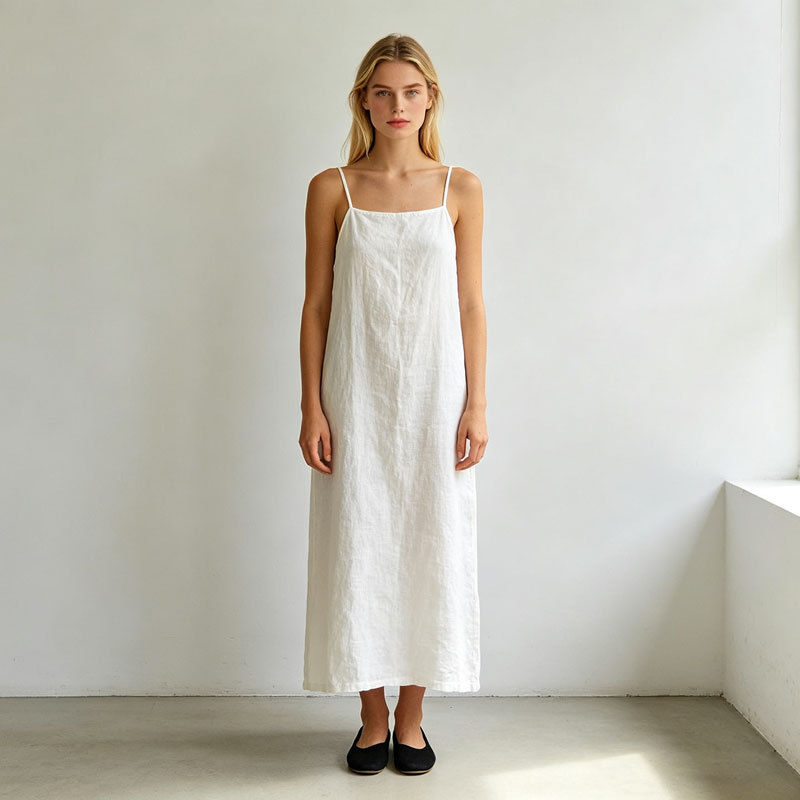
| Linen midi dress | One-step dressing that still looks considered — for warm days, travel, and easy evenings. | Natural, black, olive |
| Wide-leg linen trousers | Comfortable polish — the bottom that works from city days to summer holidays. | Oatmeal, black, sand |
| Matching linen set | Maximum combinations per item — worn together or separated into multiple outfits. | Cream, sand, black |
| Linen top or camisole | The breathable layer that works alone or under shirts, blazers, and knitwear. | White, cream, neutral |
When you choose these pieces, apply the quality checks from Step 3 — composition, origin, weight, pre-washing — because a mindful wardrobe is only as durable as its weakest garment. And choose a palette that combines easily: roughly 70% neutrals and 30% accents is a practical starting point that makes a small wardrobe feel large. If you want the full methodology for building a coordinated capsule, our guide to building a linen capsule wardrobe walks through it piece by piece, and our article on building a more natural wardrobe covers the fabric-level choices.
You can see the kind of pieces that work in practice across the KOSSR collection — linen dresses, linen tops, linen pants, and linen sets — where every product page states the composition, fabric weight, and whether the style is pre-washed, so the information you need for a deliberate choice is available before you order.
Care and Repair: The Long Relationship
A mindful wardrobe treats clothing as a relationship, not a transaction — and relationships are maintained. Linen rewards this attitude more than most fabrics, because its lifespan depends heavily on how it is treated:
- Wash less, air more. Linen resists odour well, so airing a garment between wears is often enough. Less washing means less fibre stress, which directly extends the garment's life.
- Wash gently. Cool or cold water (max 30 °C), a gentle cycle, and a mild detergent without bleach protect the fibres and the colour. Hot water and harsh agitation are the fastest way to age linen prematurely.
- Air dry or low heat. Line-drying is gentlest and naturally reduces wrinkles. If you use a dryer, use low heat and remove the garment while slightly damp.
- Repair before replace. A fallen hem, a loose button, or a small seam is a ten-minute fix. Repairing keeps the piece in rotation and honours the resource already invested in it. Our linen care FAQ covers washing, drying, ironing, and stain care in detail.
Because KOSSR linen is pre-washed, it arrives having already undergone most of its shrinkage — the piece you receive stays close to its listed size across years of washing, which removes one of the most common reasons garments get abandoned. A pre-washed linen piece, cared for gently, develops the softness and character that make it more pleasant to wear in year five than in year one. That is the payoff of a long relationship with a garment — and the entire point of a mindful wardrobe.
The Honest Limits of a Mindful Wardrobe
An honest guide should also say when the mindful approach does not fit — because it fails when it is applied as dogma rather than as a tool. These are the situations where a mindful wardrobe needs adjustment:
- Your body is changing. During pregnancy, significant weight change, or recovery from illness, a long-term wardrobe strategy is the wrong tool. Buy what fits now, choose versatile affordable pieces, and rebuild the permanent wardrobe later.
- Your life context changed. A new job with a formal dress code, a move to a different climate, or a new family situation all change what your wardrobe must do. Update the system rather than forcing the old one.
- The garment is genuinely finished. Linen lasts, but nothing lasts forever. When a piece is threadbare or structurally failing, keeping it is not mindfulness — it is hoarding. Replace it with the best version of the same piece and recycle or repurpose the old one where possible.
- Mindfulness is not a moral test. Buying a linen dress because you love it is not a failure; it is a normal human act. Mindfulness is about awareness and fit, not about never buying anything again. Guilt is not a sustainable wardrobe strategy.
The honest summary: a mindful wardrobe works brilliantly for a stable lifestyle and a body in a stable state, in a climate where linen suits you. It is a tool, not an identity. Used as a tool, it saves money, space, and resources — and it makes getting dressed calmer. If you want to go deeper into the philosophy behind slower, more intentional dressing, our guide to building a slow fashion wardrobe and our article on why linen is a slow fashion essential connect the practice to the wider movement.
Frequently Asked Questions About Mindful Linen Wardrobes
What is the difference between a mindful wardrobe and a capsule wardrobe?
A capsule wardrobe is a method — a specific small set of coordinated pieces. A mindful wardrobe is an approach — awareness of what you own, why you buy, and how you wear. You can be mindful with any number of pieces; a capsule is one possible shape a mindful wardrobe can take.
How many pieces do I need for a mindful linen wardrobe?
There is no universal number. A practical starting core is five pieces — a relaxed linen shirt, a midi dress, wide-leg trousers, a matching set, and a top or camisole — in a palette that combines easily. The right number is the one your actual rotation supports, which your wardrobe audit will reveal.
How do I stop impulse-buying clothes?
Use the 30-day rule: save the item and wait a month before deciding. Name the trigger — discount, mood, identity, or social pressure — before you buy, and check whether you already own something that serves the same purpose. These three habits eliminate most impulse purchases without feeling restrictive.
Is linen really worth the higher price?
Usually, yes — when you measure cost per wear. A quality linen garment worn 150 times costs a fraction per wear of a cheaper garment worn 15 times, and linen's strength means it can last years with proper care. The "expensive" linen piece is frequently the cheaper choice over the garment's life.
Does a mindful wardrobe mean I can never buy new clothes?
No. It means you buy with awareness — deliberately, quality-first, and with a clear idea of how the piece will be worn. Mindful wardrobes grow over time; they just grow by considered addition rather than by accumulation.
How often should I audit my wardrobe?
Twice a year — typically at the change of seasons — is enough for most people. A full audit at each seasonal change keeps the wardrobe visible, and a quick monthly check of the active-rotation pile is a lightweight way to stay aware in between.
Build a Wardrobe You Actually Wear
A mindful linen wardrobe is built slowly, through awareness rather than abstinence: audit what you own, understand why you buy, decide deliberately, set boundaries, and choose pieces that last. Linen makes the practice rewarding because it is durable, timeless, and comfortable enough to be worn again and again — the fabric that rewards the exact behaviour mindfulness asks for.
If you are starting yours, browse the KOSSR linen collection — 100% European flax, pre-washed, with composition, weight, and care stated on every page, so you can choose deliberately rather than on impulse. Have questions about fit, fabric, or building your wardrobe? Talk to our team — we are happy to help you choose pieces you will still be wearing years from now.