Linen Fabric FAQ · Linen vs Silk
Is Linen Better Than Silk?
The direct answer: no single fabric is better — linen is better for everyday wear, and silk is better for evening and occasion wear. Linen is a breathable flax fibre that stays cool, machine-washes at 30°C and grows softer with age, which makes it the stronger choice for garments you wear often. Silk is a protein filament with a lustre and fluid drape that linen cannot reproduce, and it insulates warmth without weight, which makes it the stronger choice for evening pieces, luxury layering and formal occasions. Judge the two by the job the garment has to do, and both will earn a place in your wardrobe.
This answer covers the real decision points — drape, care, durability, cost per wear and scenario — so you can decide fabric by fabric rather than by reputation. For the everyday plant-fibre comparison many shoppers actually need, our linen vs cotton comparison applies the same framework.
The Short Answer in One Table
If you want the verdict before the detail, the table below maps the dimensions that usually decide the choice. Read across a row and notice how often the "winner" switches depending on what the garment needs to do.
| Question |
Linen |
Silk |
| Better for hot, humid days? |
Yes — moves air and moisture, dries fast |
Less so — insulates, can cling |
| Better for evening or formal wear? |
Structured and matte; smart-casual range |
Yes — sheen and fluid drape read as dressy |
| Easier to care for? |
Yes — gentle 30°C machine wash |
No — hand wash cool or dry clean |
| More durable with frequent wear? |
Yes — strong, stronger when wet, softens |
Careful handling needed; weaker when wet |
| Better value for weekly basics? |
Yes — mid-tier price, low care cost |
Premium price; best reserved for occasional wear |
| Better warmth-to-weight? |
Breathable; a base or mid layer |
Yes — insulating without bulk |
If you want only one fabric for the majority of your wardrobe, that fabric is linen. If you want one fabric for the moments that matter most, that fabric is silk. Owning both, each in the role it suits, is the answer most well-dressed wardrobes arrive at.
Drape and Appearance: What Each Fabric Does to a Silhouette
Appearance is the fastest way to see the difference. Drape is how a fabric hangs under its own weight; lustre is how it handles light. Silk wins on both, which is why it reads as luxurious even before anyone touches it — but that quality is tied to the silhouettes and situations it suits.
Silk drapes and glows. Because silk is a fine continuous filament, it falls in soft, fluid folds and skims the body instead of standing away from it. On a bias-cut slip, a camisole or a wrap blouse, that movement and sheen is the whole design intention. Silk catches indoor evening light beautifully, which is exactly why it dominates occasion dressing.
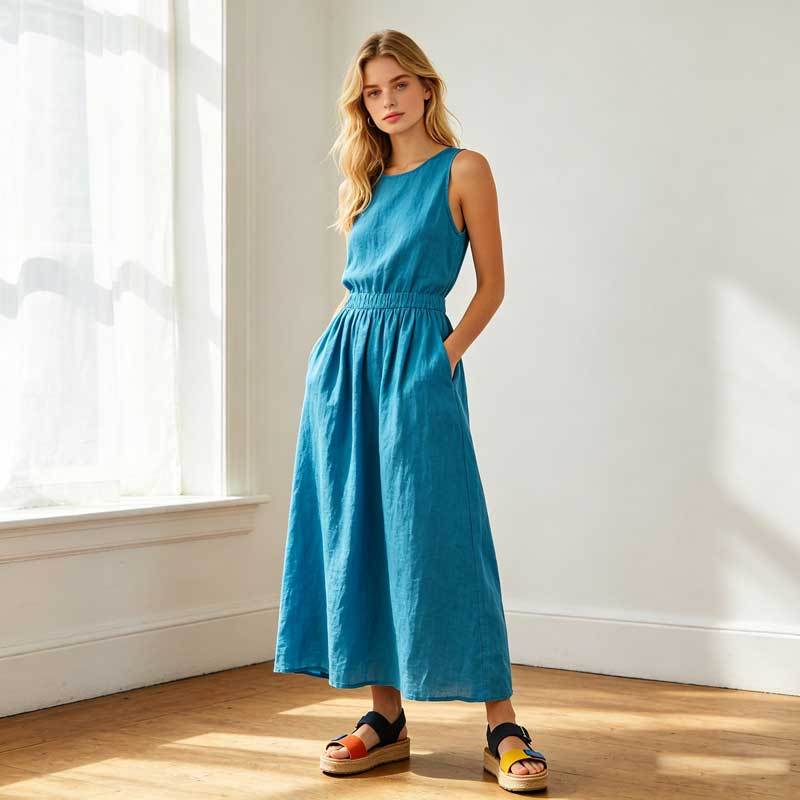
Linen holds its shape and calms the light. Linen's slightly irregular yarn gives it a matte surface and a subtle texture. A structured linen shirt dress keeps a defined collar and placket, looks crisp in daylight, and reads relaxed rather than theatrical. The soft creases that form as you move are characteristic, not a defect — a well-made, garment-washed linen piece creases gently rather than sharply.
| Silhouette |
Fabric that flatters it |
Reason |
| Structured shirt or shirt dress |
Linen |
Holds collar and front shape; matte finish suits daylight |
| Bias-cut slip dress |
Silk |
Needs fluid movement and sheen to skim the body |
| Relaxed summer trousers |
Linen |
Breathes, keeps a clean line, washes easily |
| Evening blouse or wrap |
Silk |
Lustre and light movement read as dressy after dark |
Whichever fabric you choose, the silhouette should lead. A structured linen shirt and a fluid silk blouse both look considered when the cut matches the fabric's natural behaviour — and for a matte but still elegant everyday version, a linen button-up shirt is the workhorse that anchors a wardrobe.
Care: Which Fabric Fits Your Real Life
Care is where linen and silk separate most clearly, and it matters more than most shoppers expect because a demanding care routine becomes a recurring cost. Linen is one of the most low-maintenance natural fabrics you can own; silk is one of the most delicate.
Garment-washed 100% flax takes a gentle 30°C machine cycle with mild detergent, a short spin and a line dry, and it often needs no ironing at all — soft creases fall out overnight on a hanger. Silk, by contrast, should be hand washed in cool water with a pH-neutral detergent or dry cleaned, never wrung or tumbled, and always dried in the shade because sunlight degrades the fibre. It also marks easily from perspiration and deodorant, so it benefits from being freshened after each wear. Complete linen instructions live in our linen washing guide.
The one-question test: if you will machine-wash the garment often, choose linen. If you are happy to hand wash or dry clean a piece you wear a few times a season, silk's routine is manageable and its rewards are real.
When creases do appear, a quick steam is usually all linen needs — our wrinkle removal guide shows how little effort the fabric actually asks for.
Value: Price, Durability and Cost Per Wear
Silk is one of the most expensive natural fibres because producing it is inherently slow: silkworms must be raised, cocoons harvested, and long continuous filaments reeled. Linen sits in a middle price tier — flax is grown widely across Europe and spun from the whole stalk, and modern garment-washing removes the stiffness that once limited it. The value comparison, however, is not about the price tag; it is about cost per wear.
A linen shirt worn once a week for three years is roughly 150 wears, and because linen tolerates machine washing and softens rather than degrades, those wears are realistic. A silk blouse worn twice a season is closer to a dozen wears, which changes the maths entirely. Neither result is wrong — they simply reflect different roles. We break down the reasoning further in is linen clothing worth buying and in the answer on whether linen gets softer over time.
| Use case |
Better value |
Why |
| Shirts and trousers worn weekly |
Linen |
Machine-washable, durable, improves with age |
| Neutral capsule pieces |
Linen |
Structured, tonal, easy to combine and rewear |
| Occasion blouse or wrap |
Silk |
Premium drape and sheen justify the price for special moments |
| Lightweight thermal layer |
Silk |
Warmth without bulk is hard to match in other fibres |
For the wider reasoning on why natural fibres carry a higher tag price, see our explainer on why linen clothing costs more — the same production logic that makes silk a premium fibre.
How Each Fabric Ages — and What That Means for Buying
How a fabric behaves over months and years matters as much as how it feels on day one, and linen and silk age in very different ways. Linen improves. Repeated washing relaxes the fibre further, and a good garment-washed linen piece becomes noticeably softer and more comfortable over time without losing strength — the opposite of the "wearing out" most people expect. Silk, by contrast, can stay beautiful for years but is more sensitive to how it is treated: sunlight, harsh detergent and aggressive washing can dull its lustre or weaken the fibre, so its longevity depends heavily on the care it receives.
That difference shapes what to buy where. A linen shirt or pair of trousers that you intend to wear for years is a low-risk purchase, because the fabric tends to get better with use and forgives normal household care. A silk piece is a worthwhile purchase when you accept the gentler routine it asks for in return. Neither fabric is fragile in the abstract — they simply reward different kinds of attention.
- Linen: softens with each wash, resists wear, becomes more flattering over time.
- Silk: retains drape and sheen with careful handling, but dulls or weakens if washed or dried aggressively.
- For both: store clean, away from direct sun, and give linen room to breathe on a hanger rather than crumpling it into a tight pile.
A little routine goes a long way: the guide to storing linen clothing covers folding, hanging and protecting pieces between seasons so both fabrics stay in good condition for years.
Buying Signals: How to Spot Real Linen and Real Silk
Because the two fabrics sit in different price tiers, both attract imitations, and knowing the real markers stops you paying a premium for an impersonation.
| Signal |
Real linen |
Real silk |
| Label |
"100% linen" or "100% European flax" |
"100% mulberry silk" with a momme figure |
| Look |
Matte with subtle natural texture |
Deep, shifting lustre, not flat shine |
| Feel |
Soft but structured, cools the hand |
Smooth, cool, light and fluid |
| Care guidance |
Gentle 30°C machine wash |
Hand wash cool or dry clean |
Watch for vague terms such as "silk-touch" or "linen-look", which usually describe synthetics that mimic the feel without the properties. If a product claims to be silk but recommends a hot machine wash, that is a sign it is not genuine. For linen specifically, checking fibre content, weight and garment-washing notes tells you most of what you need — and our related answer on whether linen gets softer over time explains why those finishing choices matter.
Scenarios: When to Choose Linen, When to Choose Silk
Fabric choices get easy once you match the material to the moment. These are the situations where each clearly wins.
Choose linen when:
- The weather is warm or humid. Linen's breathability and quick drying keep you comfortable where silk can cling and feel warmer.
- You will wear the garment at least weekly. Shirts, trousers, shorts and everyday dresses should be easy to wash and hard to wear out — linen's territory.
- You are travelling. Linen packs flat, tolerates being folded, and looks deliberately relaxed rather than crushed. Our linen pants and separates travel especially well.
- You want a neutral capsule. Linen holds shape in earthy neutrals, so a few pieces combine endlessly across seasons.
- You want low-maintenance care. A gentle 30°C wash and a hanger cover most of it.
Choose silk when:
- The occasion is after dark. Dinners, celebrations and formal events reward silk's sheen and fluid drape.
- You need warmth without weight. A thin silk layer insulates where bulk is unwelcome.
- The silhouette is fluid. Bias-cut dresses, camisoles and wrap tops depend on drape silk provides.
- You are buying an heirloom or gift. Silk scarves and blouses signal occasion in a way linen rarely does.
Honest limits: linen will not deliver liquid evening drape or high-sheen glamour, and it wants a layer over it below about 10°C (50°F). Silk does not like frequent machine washing, direct sun, or heavy daily wear. Choosing against a fabric for the wrong job is not a fault of the fabric — it is a mismatch.
Can You Wear Linen and Silk Together?
Absolutely — and combining them is often the cleverest option, because each covers the other's weakness. Linen brings structure, breathability and easy care; silk brings sheen, drape and warmth. Side by side, the matte-versus-lustrous contrast looks intentional.
- Silk as the inner layer, linen on top. A silk camisole or slip under an open linen shirt gives cooling linen against the day and a glimpse of sheen for the evening.
- Linen as the base, silk as the accent. A silk scarf or silk-trimmed detail lifts a linen shirt dress without exposing a delicate piece to daily wear.
- Keep both in one tonal family. Natural, sand, cream and ink let the texture contrast do the styling work with no clash.
- Separate the care. Linen can join a gentle machine load; silk goes to hand washing or the dry cleaner. Keeping them apart protects both.
The result is a wardrobe where linen handles the everyday and silk handles the exceptional — which is exactly how each fabric performs best. For the everyday plant-fibre alternative to silk, see our comparison of linen vs hemp, another natural fibre that pairs well with a linen-led wardrobe.
Related Questions
Is linen cooler than silk in summer? — Generally yes. Linen moves air and moisture away from the skin and dries quickly, while silk insulates more and can cling in heat and humidity.
Can you machine wash linen but not silk? — That is the usual rule: garment-washed linen takes a gentle 30°C cycle, while silk should be hand washed cool or dry cleaned. See the linen washing guide.
Which is stronger, linen or silk? — Silk is strong when dry but weaker when wet; linen is strong for its weight and stronger when wet, which is why it endures regular washing better. See is linen better than hemp for another natural-fibre comparison.
Which should I buy for a dress? — Choose linen for a dress you will wear often in warm weather; choose silk for an evening or formal dress. A structured linen shirt dress covers elegant everyday wear in a single piece.