Linen Cardigans & Knit-Style Layers: Autumn Comfort in Natural Fibers
- Share
- publisher
- KOSSR
- Issue Time
- Sep 24,2026
Summary
A linen cardigan is an open-front knit-style layer cut from 100% European Flax, and it carries a linen wardrobe through autumn by holding air in the knit while the fibre keeps releasing moisture. This guide covers five knit-style layer types, a weight guide from 110 to 140 gsm for September to 190 to 240 gsm for late fall, four outfit formulas, temperature bands from 27 C down to 6 C, care instructions and what to check before buying.
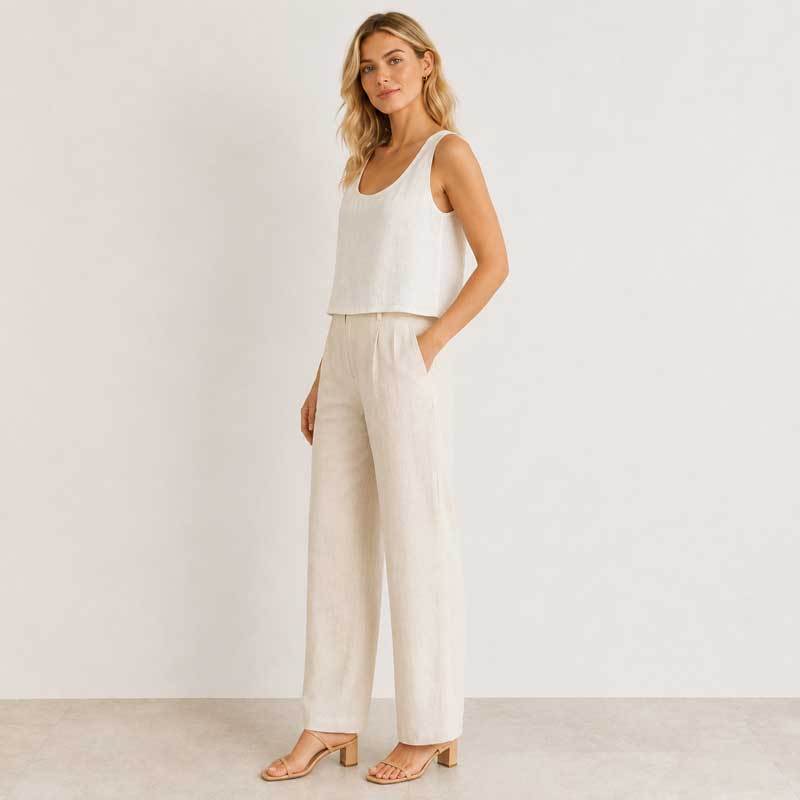
Direct answer: A linen cardigan is an open-front, knit-style layer cut from 100% European Flax, and it works as autumn outerwear because loose linen knits trap air between the fibres while still moving moisture away from the body. Choose it by weight, not by name: 110 to 140 gsm is a September layer over a tank or tee, 150 to 180 gsm covers most of October over a linen shirt, and 190 to 240 gsm is the piece that takes you into a mild November when worn over a long-sleeve linen top. Wear it between roughly 18 °C and 24 °C on its own, layer a heavier cardigan or overshirt underneath a coat below 15 °C, and treat linen as the base layer rather than the outer layer once temperatures drop under 10 °C. Linen is garment-washed so it arrives relaxed and pre-shrunk, which is why it layers flat instead of adding bulk. The guide below covers the five knit-style layer types, a weight-to-month table, four outfit formulas, temperature bands, and the care routine that keeps a linen layer soft for years. The word cardigan has drifted a long way from its origin. In a modern wardrobe it describes a shape, not a fibre: an open-front layer with a button placket or an open edge, long sleeves, and a collarless neckline, worn over something and closed at will. That shape can be cut from wool, cotton, cashmere, synthetic blends, or linen. When a brand offers a linen cardigan, what it is really selling is that open-front shape made from flax fibre, which means the piece inherits every behaviour of linen: it feels cool to the touch at first, it releases moisture quickly, it creases, and it has a dry, slightly rustic surface that shows the weave. That combination is the source of both the appeal and the confusion. Shoppers who expect a linen cardigan to behave like a wool cardigan are usually disappointed in November, because linen is not an insulating fibre in the way wool is. Shoppers who understand it as a mid-season and indoor layer are usually delighted, because nothing else in a natural-fiber wardrobe breathes like it while still covering the arms. The practical way to think about the piece is this: a linen cardigan is not a coat replacement, it is the layer that makes a linen tee or a linen shirt wearable for another six to ten weeks on either side of summer. There is also a second, less obvious definition worth knowing. In linen, and especially in budget linen, a cardigan may be a woven open-front jacket rather than a knitted garment. A woven linen jacket has no stretch and a crisper drape; a knit linen cardigan stretches slightly, moves with the shoulder, and feels softer against the skin because the loops of yarn create a cushioned surface. Both are useful, and both belong in a fall wardrobe, but they layer differently, so the next section deals with that distinction directly. KOSSR cuts in 100% European Flax and garment-washes every piece before it ships, which means the garment in your hands has already been through the shrinkage that surprises people at the third wash. That pre-shrunk, relaxed state matters more in a layer than in a tee, because a layer needs to sit over another garment without tugging at the shoulders. If you are new to the fibre, the general framework in whether you can wear linen in the fall explains the climate logic before the styling logic. The same fibre produces two very different fabrics depending on how it is built. A woven linen shirt is a grid of straight warp and weft yarns, dense and smooth, and its performance comes from the gaps between the yarns and the smoothness of the fibre surface. A knit linen layer is a series of interlocking loops, and its performance comes from the air held inside those loops. That single structural difference explains most of what people notice when they wear one. Linen fibre itself is a cellulose fibre with a naturally high moisture regain, which means the fibre absorbs and releases water vapour readily rather than sealing it against the skin. It also conducts heat away from the body faster than cotton, which is why linen is famously described as cool in summer. In a loose knit, however, the fabric holds a layer of still air between the loops. Still air is the actual insulator in any warm garment, which is why a chunky linen knit worn over a shirt feels noticeably different from a thin linen shirt worn on its own, even though both are the same fibre at the same temperature. The result is a piece with an unusual profile: it insulates a little through structure, breathes a lot through the fibre, and never builds up the clammy feeling that synthetic fleece and tightly woven synthetic blends produce when you move indoors. This is also the reason the switch from summer to autumn in a linen wardrobe is a matter of weight rather than replacement, a point set out in transitioning your linen wardrobe from summer to fall. For autumn, that profile fits the problem precisely. Autumn is not cold; it is unstable. A morning at 9 °C and an afternoon at 22 °C is a normal October day in much of Europe and the northern United States, and a layer that you can open, roll, or remove is more useful than a layer that simply keeps heat in. The trade-off is honest and worth stating plainly. Linen gives you breathability, a dry hand, and a temperature range you can manage by opening and closing the front. It does not give you the loft of wool, the elasticity of a synthetic knit, or wind resistance. Used below roughly 10 °C on its own, a linen layer will feel cool, and that is not a fault in the garment, it is the fibre behaving exactly as it should. Worn in its band, it is one of the most comfortable layers a natural-fiber wardrobe can hold. The one-line version. A woven linen piece manages heat by passing air and moisture through the cloth. A knit-style linen layer manages heat by holding air in the loops and releasing moisture through the fibre. The knit is the better autumn layer for unstable weather; the woven is the better layer for windless warm afternoons. Not every open-front linen piece does the same job. The table below compares the five shapes that most people mean when they say "linen cardigan", with the weight band and the temperature window each one actually suits. Read the last column first if you are deciding what to buy for a specific two-month stretch. The first three rows are the same fibre at three weights, and the difference between them is larger than most shoppers expect. A 130 gsm linen cardigan and a 220 gsm linen cardigan can look nearly identical on a hanger and behave like two different garments on the body, because the heavier knit holds far more air and drapes with more weight. The fourth row is the woven option, and it earns its place for a specific reason: a woven linen overshirt holds its shape over a shirt, reads slightly more formal, and slides under a heavier coat without bunching. Its weakness is the opposite of the knit's: it has no give at the shoulder, so sizing matters more. The fifth row is where most commercial "linen cardigans" actually sit. A linen-cotton or linen-viscose knit gains softness, elasticity and a little warmth at the cost of some of the pure dry hand and the crispness that make 100% linen recognisable. Neither choice is wrong. If your aim is breathability and a natural surface, pure linen is the point; if your aim is a soft, stretchy autumn knit that happens to contain flax, a blend will serve you better. KOSSR pieces are pure 100% European Flax, so the weight is the variable you control when you shop. Fabric weight, measured in grams per square metre, is the single most useful number on a linen product page, and it is the number most shoppers ignore. Temperature alone does not decide what you wear, because wind, humidity, sun and indoor heating all shift the answer, but weight plus an outer layer gets you close. The table below maps weight to month for a temperate autumn climate and assumes you are wearing a lightweight linen top underneath. Two rules keep this table useful in practice. First, weight is what you buy, layers are what you adjust: a 160 gsm cardigan over a short-sleeve top and the same cardigan over a long-sleeve shirt differ by roughly one full month of wearability. Second, linen layers stack without bulk, unlike fleece, so adding a second thin layer is usually more comfortable than switching to one heavy piece. Above 27 °C the layer is unnecessary and a linen tee or dress will be more comfortable. Below about 7 °C linen stops being effective as the outer layer and becomes excellent as the base: it sits smooth under wool, does not build static the way synthetics do, and absorbs the moisture that would otherwise make a wool layer feel damp after a walk or a commute. When in doubt, buy the middle weight. A 150 to 180 gsm linen cardigan is the piece that gets worn from mid September to early November in most temperate climates, and it is the one worth choosing first. The pieces themselves, with fabric weight listed for each, sit in the linen outerwear collection. Formulas beat rules, because a formula can be executed with whatever is already in the wardrobe. Each of the four below assumes a 100% linen base and a linen layer, and each has a defined temperature window so you can pick the right one from the morning forecast rather than guessing at the door. Two small adjustments make all four formulas work better. Roll or push the sleeve to just below the elbow rather than to the shoulder, so the forearm stays exposed in warmer hours and the cuff does not stretch. And choose the layer's length deliberately: a cardigan that ends at the hip keeps a vertical line with wide trousers, while one that ends mid-thigh reads more like a coatigan and should be worn open with narrow trousers. These are the same proportions that make linen blazers and jackets for fall layering work, and they translate directly to knits. Most layering mistakes happen two minutes before leaving the house, when the decision is made on the indoor temperature rather than the outdoor one. The table below is a fast lookup: find the outdoor range, then read across for the base, the linen layer and the extras. It assumes light activity outdoors and a heated indoor environment at the destination. The pattern in that table is worth naming, because it is the opposite of what most people do. As the temperature falls, the linen moves inward, not outward. Linen earns its keep as a next-to-skin layer because it manages moisture and stays smooth; it earns its keep as an outer layer in mild, changeable weather because it breathes and can be opened. Deciding which of those two jobs the day requires is the whole art of dressing in linen through autumn. Humidity and wind shift these bands by a few degrees in either direction. A dry, still 14 °C day feels warmer than a damp, breezy 17 °C day, and a linen layer handles the damp case better than most fabrics because the fibre releases moisture instead of holding it against the skin. That is the practical reason linen performs well in coastal autumn weather, and it is also why the same piece can feel cool in a dry indoor room with the heating on at 24 °C: linen is following the conditions, not fighting them. A linen knit layer has a matte, slightly irregular surface that reacts to colour differently from a smooth wool or a flat synthetic knit. The short list below covers the decisions that change how the outfit reads, in the order that matters most. Length, more than colour, decides whether a linen layer flatters. The reliable proportions are a layer that ends at the hip bone over wide-leg trousers, a layer that ends mid-thigh worn open over narrow trousers, and a cropped layer over a high-waisted skirt or trouser where the waist line stays visible. If a linen cardigan feels shapeless, the fix is usually the bottom half rather than the layer: swap a wide trouser for a straight one, or add a belt. Wearing linen with linen is the fastest route to a cohesive autumn look, and also the fastest route to looking creased and unplanned if the weights and tones are chosen carelessly. Three principles solve it. Separate the weights by at least 40 gsm. A 130 gsm shirt under a 180 gsm cardigan gives a clear structural contrast; a 160 gsm shirt under a 170 gsm layer gives nothing. The eye reads the difference in drape before it reads the colour, so the weight gap is the primary signal that two pieces are layered rather than accidentally matched. Either match the tone exactly or separate it clearly. Undyed flax over undyed flax is elegant and easy. Beyond that, choose tones that differ by at least a few shades: oatmeal over white, olive over sand, clay over pale grey. Two tones that are nearly but not quite the same are the ones that look like a mistake. Plan for creasing instead of resisting it. Linen creases, and in an all-linen outfit the creases are part of the surface, which is why garment-washed linen that has already softened reads far better than a crisp, unwashed cloth. Let the fabric relax: a garment-washed cardigan over a garment-washed shirt looks intentional in a way that two stiff new pieces do not. If you want the same effect on a linen dress rather than a top, the logic is identical, and the layered version is set out in styling a linen dress for fall. Not every all-linen combination needs two separate garments. A linen set, meaning a matched top and trouser cut from the same cloth, gives the same coherence with none of the matching effort, and a knit-style layer in a slightly different tone over the set turns it into a third outfit. This is the reason the linen sets collection and the outer layer collection work so well together: the set supplies the base, the layer supplies the season. A knit-style linen layer is easier to care for than its delicate appearance suggests, because linen is stronger when wet than when dry and does not felt or mat the way wool does. The routine is short, and following it is what keeps the knit from losing its shape at the shoulder and hem. Steam is the shortcut that makes the layer look pressed without flattening the knit's texture. Hold a steamer a few centimetres from the cloth, work down the front panels and the sleeves, and let the piece hang for a few minutes before wearing. If you prefer an iron, use the lowest setting with steam and press lightly rather than sliding the plate, which can flatten the loops and leave a shine. The full method for the fibre is set out in the complete linen care guide, and the questions that come up most often about washing are answered in how to wash linen clothing. Because every KOSSR piece is garment-washed before it ships, the first wash at home will not surprise you: the piece has already settled. Most disappointment with linen layers comes from four avoidable habits rather than from the fabric itself. There is also a seasonal mistake worth naming: treating linen as a summer-only fibre and packing it away in September, exactly when a midweight layer would earn the most wear. The fibre does not become unsuitable when the calendar changes; it becomes the base layer instead of the outer layer. If you are unsure where the boundary sits, the honest answer is that it is a temperature boundary rather than a month boundary, and whether linen is warmer than cotton sets out the comparison that decides it. Four checks separate a linen layer that will be worn for years from one that will sit in the wardrobe after a month. Check the composition, not the name. A piece labelled "linen blend" can contain a small fraction of flax and a large fraction of synthetic fibre. If breathability is the reason you are buying, the label should read 100% linen. A blend is a legitimate choice for softness, stretch and warmth, but it behaves differently and should be chosen deliberately. Check the weight in gsm, or read the product description for the weight band. Weight is the strongest predictor of when the piece will be wearable, and it is listed on the product pages, including the linen tops collection, and it is listed on the packaging in many cases. If a listing gives no weight, treat the piece as a light layer until you feel it. Check whether it is garment-washed. Garment washing softens the fibre, removes the starch stiffness of new linen, and settles the final size before the piece reaches you. It is the difference between a layer that drapes on the first wear and one that needs three washes to relax. Check the shoulder and the seam allowance. Hold the cardigan by the shoulders and let it fall: the seam should sit on your shoulder point, not beyond it. Check the inside of the placket and the armhole for a clean finish, since a knit layer is opened and closed many times a day and the placket takes the wear. One further note on fit: because linen knit has limited elasticity, the comfortable size is the one that closes over a shirt without pulling. If you plan to wear it over a long-sleeve linen shirt in October, try it on over a shirt rather than a tee. Get that one detail right and the layer will be worn far more often than a piece bought for looks alone. For mild autumn, yes, provided you match the weight to the temperature. A 150 to 180 gsm linen cardigan is comfortable alone from about 17 to 22 °C and over a long-sleeve linen shirt from about 13 to 18 °C. Below roughly 10 °C linen works better as the base layer under a wool coat than as the outer layer, because linen insulates mainly through the air held in the knit rather than through the fibre itself. A cardigan is knitted, so it stretches slightly, moves with the shoulder and has a soft, looped surface. A linen jacket is usually woven, so it holds a crisper shape, has no give and reads more formal. For layering over a shirt in changeable weather the knit is more comfortable; for sliding under a coat without bunching, the woven piece is easier. Open above about 18 °C and buttoned below it. Leaving the front open lets air move through the layer, which is the behaviour you want in mild weather. Buttoning closes that airflow and traps a thin layer of warmth, which is what you want in the mid teens. Buttoning only the middle two buttons gives both a defined waist and a relaxed chest. Linen knit has limited elasticity, so it holds its cut better than a wool knit and stretches less over time. The two things that distort it are hanging it wet and wringing it out. Dry it flat in shade and store it folded, and the shoulder and hem will keep their line season after season, especially in a garment-washed piece that has already settled. Yes, and the proportions matter more than the fabric. Choose a layer that ends at the hip bone or mid-thigh worn open, keep the base narrow, and let the weights differ by at least 40 gsm so the two pieces read as separate layers. A 150 to 180 gsm cardigan over a 110 to 140 gsm dress is the combination that works most reliably between 17 and 22 °C. A linen cardigan is the piece that extends a linen wardrobe from late summer into autumn, and it works because a knit structure traps air while the flax fibre keeps releasing moisture. Choose it by weight: 110 to 140 gsm for warm early-fall days, 150 to 180 gsm for the core of the season, 190 to 240 gsm for mild late fall. Wear it open above 18 °C and buttoned below it, put a long-sleeve linen shirt underneath as the temperature drops, and move the linen to the base layer under wool once the day falls under 10 °C. Keep the palette natural, let one piece carry the texture, separate the weights when you layer linen over linen, and care for the knit flat rather than hung. Nothing about the fibre needs managing beyond that. Because every KOSSR piece is 100% European Flax and garment-washed before it ships, the layer arrives soft, relaxed and true to size, and the fibre gets softer with every wash rather than wearing out. What linen asks for is different from what wool asks for: it wants to be understood as a breathable, moisture-managing layer rather than a heat-retaining one, and once that clicks, a cardigan becomes the most-worn piece in the autumn wardrobe. Build the autumn layer around weight, not guesswork: browse the linen outerwear collection and the linen tops collection, where fabric weight and composition are listed for every piece, then pair a midweight knit-style layer with a long-sleeve linen shirt and the 30 °C wash routine in this guide so it stays soft, relaxed and wearable from September through November.Linen Cardigans & Knit-Style Layers: Autumn Comfort in Natural Fibers
1. What a Linen Cardigan Really Means in a Natural-Fiber Wardrobe
2. Why Linen Behave Differently in a Knit Than in a Woven Shirt
3. The Layer Line-Up: Five Knit-Style Layers Compared
Layer type Typical weight Warmth Best temperature Best for Light knit cardigan, open front 110 to 140 gsm Low 21 to 26 °C Cool evenings, air-conditioned rooms, travel Midweight knit cardigan 150 to 180 gsm Low to medium 17 to 22 °C The core September and October layer Heavyweight knit cardigan or coatigan 190 to 240 gsm Medium 12 to 18 °C Mild November days and shoulder-season evenings Woven linen overshirt or chore jacket 170 to 220 gsm Medium 13 to 20 °C Windless days, a crisper look, layering under a coat Linen-blend knit layer 160 to 210 gsm Medium to high 10 to 17 °C Late fall, when a little elasticity and loft is welcome 4. Choosing by Weight: A GSM Guide from September to November
Month band Typical daytime range Linen layer weight What it goes over Early September 22 to 27 °C 110 to 140 gsm, or none Tank, sleeveless dress, short-sleeve tee Late September 18 to 24 °C 130 to 160 gsm Short-sleeve shirt, light tee Early October 14 to 20 °C 150 to 180 gsm Long-sleeve linen shirt Late October 10 to 16 °C 180 to 210 gsm Long-sleeve shirt plus a thin base Mild November 7 to 13 °C 200 to 240 gsm over a wool or knit base Base layer plus linen layer plus scarf 5. Four Outfit Formulas That Work Over a Linen Top
6. Temperature Matching Without Overthinking It
Outdoor range Base Linen layer Extras 24 to 27 °C Linen tank or tee None, or a 110 gsm layer carried Sunglasses, brimmed hat 20 to 23 °C Linen tee or short-sleeve shirt 130 to 150 gsm, open front Linen scarf in a bag for evening 16 to 19 °C Long-sleeve linen shirt 150 to 180 gsm, partly buttoned Belt, closed shoes 11 to 15 °C Linen shirt plus thin cotton base 180 to 210 gsm, buttoned Linen or cotton scarf, ankle boots 6 to 10 °C Linen shirt as base under a wool layer 110 to 140 gsm under a coat Wool coat, scarf, gloves 7. Colour, Texture and Proportion Rules
8. Linen Over Linen: Making an All-Linen Layer Look Intentional
9. Care for Knit-Style Linen Layers
10. Common Mistakes That Make Linen Feel Cold or Clammy
11. What to Look For When You Buy a Linen Cardigan
12. Questions People Ask About Linen Cardigans and Knit Layers
Is a linen cardigan warm enough for autumn?
What is the difference between a linen cardigan and a linen jacket?
Should a linen cardigan be worn open or buttoned?
Will a linen knit layer stretch or lose its shape?
Can I wear a linen cardigan over a linen dress?
13. The Short Answer, Restated