Linen Guides · Fabric Comparison
Linen vs Silk: When Each Fabric Deserves a Place in Your Wardrobe
The direct answer: linen and silk are not competitors — they solve opposite problems, and the wardrobe that gives each one a defined role is the one that feels effortless. Linen is the everyday workhorse: a breathable cellulose fibre spun from flax that keeps you cool, survives machine washing and improves with age. Silk is the specialist: a protein filament reeled from silkworm cocoons that drapes, glows and insulates in a way no other natural fabric matches. Put linen where the day happens — warm offices, long walks, travel, weekends — and put silk where a moment calls for polish, fluidity or warmth without weight. KOSSR's own range is 100% European flax, garment-washed so it arrives soft and pre-shrunk, while silk belongs in your wardrobe for the occasions a relaxed linen shirt will not cover.
This guide compares the two fibres honestly — origin, drape, breathability, care, durability and real cost of ownership — then gives you a simple rule for deciding which deserves your money for a given garment. There is no marketing claim here that a linen brand cannot back up: we explain where a linen shirt dress beats silk, and where silk still wins outright.
Linen vs Silk at a Glance: Two Natural Fibres, Two Different Jobs
Before the detail, here is the whole comparison compressed into one table. Read it as a decision aid rather than a scoreboard — the point is not that one fabric is superior, but that they are built for different moments. If you want the wider version of this logic against a plant fibre, our linen vs cotton comparison runs the same analysis for the most common everyday choice.
| Dimension |
Linen |
Silk |
| Fibre source |
Cellulose fibre from the flax plant (bast fibre) |
Protein filament (fibroin) reeled from silkworm cocoons |
| Surface & light |
Matte, slightly textured, diffuses light |
Lustrous, smooth, reflects light with a natural sheen |
| Drape |
Structured; holds a shape, softens with washing |
Fluid; falls and moves with the body |
| Best temperature role |
Cooling in heat; breathable as a base or mid layer |
Warmth-to-weight; insulating without bulk |
| Everyday care |
Machine wash gentle at 30°C, line dry, light iron optional |
Hand wash cool or dry clean; shade dry; careful ironing |
| Durability in use |
Very strong, stronger when wet; softens rather than wears out |
Strong dry, weaker when wet; sensitive to sun and abrasion |
| Typical price tier |
Mid-tier; value improves over years of wear |
Premium; production cost is inherently higher |
| Signature use |
Summer, work, travel, casual and smart-casual |
Evening, formal events, luxury layering, occasion wear |
Notice that almost every advantage flips depending on the job. Linen's crispness is a virtue in a structured shirt and a limitation in a bias-cut slip dress; silk's fluidity is the whole point of that slip dress and a liability in a garment you want to wash weekly. That is the entire argument in one line.
What Actually Separates Linen and Silk
The differences people feel between linen and silk trace back to fibre structure, not marketing. Understanding the structure explains every practical trade-off that follows — why linen breathes, why silk shines, why one forgives a hot wash and the other does not.
Linen: a bast fibre with air built in
Linen is spun from the stalk of the flax plant. The fibres are long, and their cross-section is irregular and slightly polygonal rather than perfectly round, which leaves microscopic gaps along the yarn. Those gaps are why linen moves air so well and why it feels cool against the skin: heat and moisture have somewhere to go. The same structure gives linen its matte finish — it scatters light instead of bouncing it back — and its faint, natural texture. Flax fibres are also unusually strong for their weight, and they gain strength when wet, which is why linen tolerates a washing machine far better than most delicate fabrics. Our own linen is 100% European flax, garment-washed before it reaches you so the fibre has already relaxed and shed most of its initial stiffness.
Silk: a continuous protein filament
Silk is a protein fibre, not a plant one. A silkworm extrudes a single continuous filament to build its cocoon, and that filament can be reeled off in long, unbroken lengths rather than spun from short staple fibres. A continuous filament is what gives silk its smoothness and its sheen: light hits an even, glass-like surface and reflects. Silk is measured by weight in momme (a Japanese unit where 1 momme equals about 3.75 grams per square metre of fabric). Lightweight silk garments such as blouses typically sit around 16–19 momme, while heavier silk for bedding runs closer to 22–25 momme. The higher the momme, the more substantial and durable the fabric — a detail worth checking when you compare two silk pieces at very different prices.
Why the origin matters to your clothing
- Strength behaviour flips: linen gets stronger when wet (safer to machine wash); silk loses strength when wet (handle gently, never wring).
- Thermal behaviour flips: linen conducts heat away from the body (cooling); silk traps air in its filament structure (insulating).
- Light behaviour flips: linen is matte (relaxed, understated); silk is lustrous (dressy, luminous).
None of these are faults. They are simply the physics of two very different fibres, and they should drive which one you buy for a given garment. For a deep dive into what linen specifically is and is not, see our answer to what linen feels like.
Drape and Sheen: The Visual Difference That Sells Silk
If you lined up a linen and a silk version of the same simple garment, the silhouette would read completely differently, and that difference is the main reason silk commands its price. Drape is how a fabric hangs under its own weight; sheen is how it handles light. Silk scores on both in a way that reads as expensive because it is expensive to produce — but that does not make it the right choice for every garment.
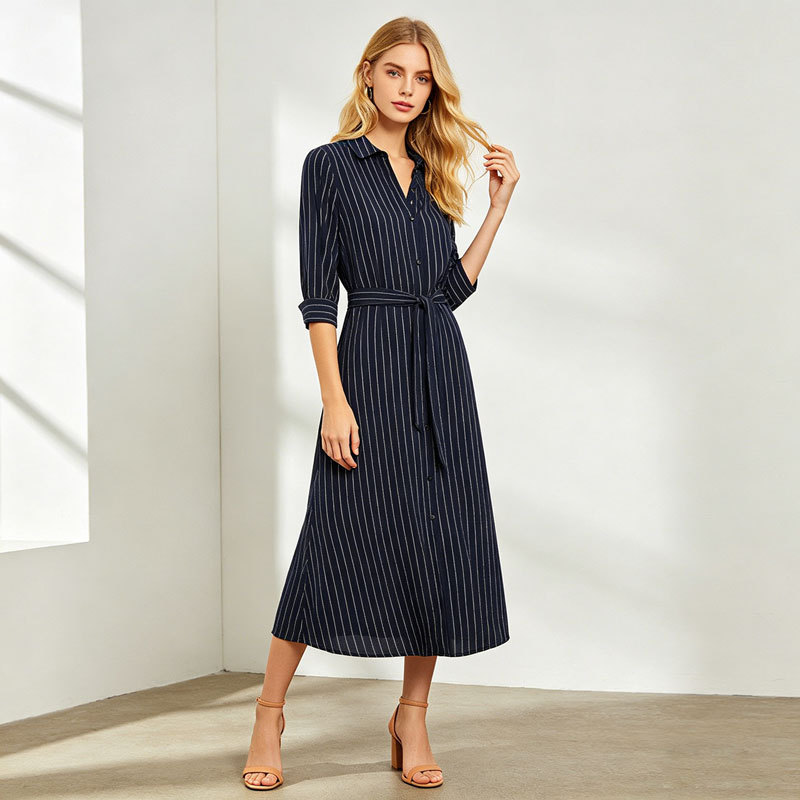
Silk drapes. Because it is a fine, flexible filament, silk falls in soft, fluid folds and skims the body rather than standing away from it. On a bias-cut slip dress, a camisole or a fluid blouse, this is the entire appeal: the fabric moves with you and catches light as you turn. A linen shirt dress, by contrast, holds a defined shape — the collar sits up, the buttons read clearly, and the garment looks deliberately structured rather than softly liquid.
Linen has presence. Linen's slightly irregular yarn gives it a subtle texture and a matte surface that photographs as relaxed and natural. In strong daylight — a summer wedding, a bright terrace — linen looks cool and unfussy where high-sheen fabrics can look overly formal. The faint creases that form as you move are part of that character: a well-made, garment-washed linen shirt creases softly rather than sharply, and those soft creases are widely read as intentional.
| Garment |
Fabric that tends to look best |
Why |
| Structured shirt / shirt dress |
Linen |
Holds collar and placket shape; matte finish suits daylight |
| Bias-cut slip dress |
Silk |
Needs fluid drape and sheen to skim rather than stand out |
| Summer trousers |
Linen |
Breathes, holds a clean line, machine-washable |
| Evening wrap or blouse |
Silk |
Luminosity and light movement read as evening-appropriate |
| Everyday button-up |
Linen |
Survives weekly washing; softens and improves with use |
The practical takeaway: choose silk when the garment's job is to look luminous and move softly, and choose linen when the garment's job is to hold a shape and be worn often. For a fuller tour of how structured linen can move between casual and polished, see our dress-up-or-down styling guide.
Breathability and Temperature: Where Linen Wins and Silk Earns Its Keep
This is the category where the two fabrics are most often compared unfairly, because people assume "breathable" is a single score and silk must lose. It does not — it just works in a different temperature band.
Linen is built for heat
Linen's irregular fibre structure and natural gaps move moisture and heat away from the skin, which is why it is one of the most comfortable fabrics to wear in warm, humid conditions. It absorbs moisture readily and releases it quickly, so it does not cling when you perspire, and it dries fast. As a general guide, a mid-weight garment-washed linen shirt stays comfortable on its own from roughly 15°C to 27°C (59°F–81°F), and it keeps working as a base layer below that range once you add a jacket or knit. If you want the fabric-level answer, our FAQ on whether linen fabric is breathable explains the mechanism.
Silk insulates without weight
Silk's superpower is warmth-to-weight ratio. Its filament structure traps air, so a thin silk layer adds noticeable warmth without the bulk of wool or fleece. That is why silk has long been used for lightweight thermal underlayers and why a silk scarf or blouse can take the chill off an evening without making you overheat. In cold, dry conditions silk is a genuine performance fabric; in hot, humid conditions it becomes less comfortable than linen because it does not move moisture as quickly and its smooth surface can cling.
The practical rule: reach for linen when the threat is heat and humidity, and reach for silk when the threat is cold or a need for elegance. On a mild, mixed day — warm indoors, cool outdoors — a linen button-up shirt on its own, with a silk scarf packed for the evening, covers both ends of the day.
Care and Durability: The Real Cost of Ownership
Sticker price is only part of what a garment costs you. The care routine a fabric demands — how you wash it, whether you dry-clean it, how long it lasts — decides the true cost per wear. On this axis, linen and silk are far apart.
Linen: wash it often, iron it rarely
Garment-washed 100% flax takes a gentle 30°C machine cycle with mild detergent, a short spin and a line dry. Hot water is the main enemy, because it can shrink and stress the fibre; avoid bleach and optical brighteners. Ironing is optional for everyday wear — the soft creases fall out overnight on a hanger — and when you do press it, a medium-hot iron with a little steam on the reverse side is enough. Because the fabric softens rather than degrades with each wash, a well-cared-for linen piece can serve for years. Our linen washing guide and the wrinkle removal guide cover the full routine.
Silk: handle it like the delicate it is
Silk is weaker when wet and sensitive to heat, sunlight and harsh detergent, so the safe routine is more careful: hand wash in cool water with a pH-neutral silk detergent, or dry clean; never wring or tumble dry; dry in the shade away from direct sun; and iron on the lowest setting, ideally with a pressing cloth. Perspiration and deodorant can mark silk, so a silk garment benefits from freshening after each wear rather than accumulating several days of use. Treated well, silk is durable — but the care it demands is real and should be part of your buying decision.
| Care step |
Linen (garment-washed flax) |
Silk |
| Washing |
Machine, gentle, 30°C maximum |
Hand wash cool with pH-neutral soap, or dry clean |
| Detergent |
Mild liquid; skip bleach and brighteners |
pH-neutral silk detergent only |
| Drying |
Line dry; tumble dry low only if necessary |
Shade dry flat; never tumble dry |
| Ironing |
Medium-hot with steam; often unnecessary |
Lowest heat, pressing cloth, reverse side |
| Sun exposure |
Tolerant; slight natural fading over years |
Degrades silk; always dry in shade |
| Ageing behaviour |
Gets softer and more comfortable |
Can yellow or weaken if mistreated |
Cost-of-ownership note: a garment that must be dry-cleaned after most wears carries a recurring cost that does not appear on the price tag. For a piece you plan to wear weekly, linen's machine-washable routine usually wins on total cost; for a piece worn a few times a season for occasions, silk's care burden is easier to absorb.
Price and Value: Why Silk Costs More and When It Is Worth It
Silk is one of the most expensive natural fibres in common use, and the reason is structural, not just brand mark-up. Producing it means cultivating silkworms, harvesting and unwinding cocoons, and reeling long continuous filaments — a slow, labour-intensive process compared with harvesting flax and spinning its fibres. Silk's rarity and its performance (lustre, drape, warmth-to-weight) set a premium that has held for centuries.
Linen sits in a middle tier. Flax is grown widely across Europe, the fibre is spun from the whole stalk, and modern garment-washing removes the stiffness that once made linen feel rustic. That combination gives linen an unusually strong value story: mid-tier price, high durability, low care cost, and a fabric that improves with age.
Cost per wear, not cost per tag
The honest way to compare is cost per wear. A garment worn once a week for three years is roughly 150 wears; a garment worn twice a season is closer to 12. Divide price by wears and the picture changes completely. A mid-priced linen shirt in weekly rotation can land at a very low cost per wear, precisely because it survives machine washing and does not need replacing. An expensive silk blouse worn occasionally can also justify its price on the same maths — but only if you genuinely reach for it often enough. We unpack that logic further in our answer on whether linen clothing is worth buying, and in the explainer on why linen clothing costs more than synthetic alternatives.
| Item |
Fabric that offers better value |
Reason |
| Shirts worn weekly |
Linen |
Machine-washable, durable, improves with age |
| Everyday trousers and shorts |
Linen |
Breathes, holds shape, low care cost |
| Occasion blouse or wrap |
Silk (if worn enough) |
Drape and sheen justify premium for special moments |
| Luxury layering / underlayer |
Silk |
Warmth without bulk is hard to replicate in other fibres |
| Capsule wardrobe core |
Linen |
Neutral colours and durable structure support repeated wear |
When Linen Is the Right Choice: Five Everyday Scenarios
Linen earns its place in the wardrobe whenever a garment needs to be worn often, washed easily and keep its composure in heat. These are the five situations where linen is not just adequate but clearly the better fabric.
- Warm and humid daytime wear. When the air is thick and the sun is high, linen's breathability and quick-drying behaviour keep you far more comfortable than silk, which can cling and hold moisture.
- Weekly-rotation basics. Shirts, trousers, shorts and everyday dresses you wear two or three times a week should be machine-washable — and that points firmly to linen.
- Travel and long days on the move. A linen shirt or pair of linen pants packs flat, tolerates being folded in a bag, and looks deliberately relaxed rather than crumpled.
- Work and smart-casual settings. A structured linen shirt reads professional in warm weather; look to our linen button-up shirts when you want polish without formality.
- Building a neutral capsule. Because linen holds shape and comes in earthy neutrals, a small set of linen sets and separates matches across itself and lasts for years.
Honest limit: linen is not the fabric for high-sheen evening glamour or for the coldest days on its own. Below about 10°C (50°F) it wants a layer over it, and it will never deliver the liquid drape of a bias-cut silk. That is not a flaw — it is simply the wrong job for the fibre.
When Silk Is the Right Choice: Four Occasions Where It Wins
Silk deserves a place in a considered wardrobe for the moments linen cannot cover. These are the four situations where silk is the better buy.
- Evening and occasion wear. When the setting is a dinner, a celebration or anything after dark, silk's sheen and fluid movement carry a formality that linen's matte surface will not.
- Lightweight warmth. For cool evenings or a cold-weather underlayer where bulk is unwelcome, silk's warmth-to-weight is difficult to replace.
- Luxury gifts and heirloom pieces. Silk scarves, blouses and slips are classic gifts precisely because the material signals occasion — a role linen rarely fills.
- Fluid, body-skimming silhouettes. Bias-cut dresses, camisoles and wrap tops depend on drape; on these shapes silk is the natural partner.
A practical way to hold both at once: keep silk for the few garments whose job is to be beautiful, and let linen handle the many garments whose job is to be worn. That allocation puts the premium fabric where its qualities are visible and the workhorse fabric where its durability matters. For the styling side of a structured linen piece that still reads elegant, see our guide to how elegant linen can look.
Can You Wear Linen and Silk Together?
Yes — and combining them is often the smartest move, because the two fabrics cover each other's weaknesses. Linen brings structure, breathability and easy care; silk brings sheen, drape and a touch of warmth. Worn together, the matte-versus-lustrous contrast reads intentional and expensive.
- Silk underneath, linen on top. A silk camisole or slip under an open linen shirt gives you cooling linen against the day and a flash of sheen when you want it — ideal for a mild day that turns into an evening out.
- Linen base, silk accent. Pair a linen shirt or shirt dress with a silk scarf or silk-trimmed belt. The accent adds polish without committing a delicate garment to heavy daily use.
- Colour-block the neutrals. Keep both fabrics in the same tonal family — natural, sand, cream, ink — and the texture contrast does the styling work with no pattern clash.
- Match the care zones. Because silk needs gentler handling, keep the two fabrics separate in the wash: linen can share a gentle machine load, while silk goes to hand washing or the dry cleaner.
This is exactly the logic behind a capsule approach: a handful of durable linen pieces for the everyday, plus one or two silk pieces for the extraordinary. To see how far a small set of structured linen pieces stretches, our linen two-piece sets and linen sets pages show the range working as complete outfits.
Buying Signals: How to Tell Good Linen and Good Silk Apart
Once you have decided which fabric a garment should be, the next question is whether the piece in front of you is a good example of it. The markers below are what separates a well-made garment from a thin imitation — and they apply whether you are shopping in a store or reading a product page online.
Linen buying signals
- Fibre content stated plainly. Look for "100% linen" or "100% European flax" rather than vague blends. A blend is not necessarily bad, but it should be labelled honestly — our linen vs linen blend guide explains the trade-offs.
- Garment-washed finishing. Pre-washed linen arrives soft, sits better and shrinks less. It is one of the clearest quality signals in a linen product description.
- A sensible weight. Summer shirts and dresses commonly sit around 130–160 gsm; heavier weights suit trousers and jackets. Extremely thin, see-through linen usually signals a compromise.
- Clean construction. Straight, even stitching, matched pattern at the seams and buttons that feel secure are as telling in linen as in any garment.
Silk buying signals
- Momme weight is declared. A reputable silk product states its momme; garments from about 16 momme upward feel substantial, while very low weights feel flimsy.
- Fibre named precisely. "100% silk" or "100% mulberry silk" is the real thing; "silk-touch" or "silky" usually means a synthetic that imitates the feel without the properties.
- Even, natural lustre. Genuine silk has a soft, deep sheen that shifts with the light; synthetics tend to look uniformly shiny and slightly plastic.
- Care instructions match the fibre. Honest silk comes with gentle-wash or dry-clean guidance; a "silk" garment labelled for a hot machine wash is a red flag.
| Signal |
Good linen |
Good silk |
| Label |
"100% linen" / "100% European flax" |
"100% mulberry silk" with a momme figure |
| Feel |
Soft but structured; gentle texture |
Smooth, cool, light with fluid movement |
| Light response |
Matte with subtle surface variation |
Deep, shifting lustre |
| Care guidance |
Gentle 30°C machine wash |
Hand wash cool or dry clean |
For a broader checklist on evaluating a linen garment, our how to tell if linen is good quality guide and the answer on whether linen gets softer over time add useful context.
Frequently Asked Questions About Linen vs Silk
Is linen better than silk?
Neither is universally better — they are built for different jobs. Linen is more breathable, machine-washable, more durable in daily use and better value for garments worn often. Silk has a sheen and drape that linen cannot match, insulates warmth without weight, and suits evening and occasion wear. Choose by the garment's role, not by a ranking.
Is linen cooler than silk in summer?
Generally yes. Linen's irregular fibre structure moves air and moisture away from the skin and dries quickly, which makes it comfortable in heat and humidity. Silk is smoother and insulates more, so in hot, humid conditions it can feel warmer and clingier than linen. In dry, cool conditions silk's warmth is an advantage instead.
Is silk stronger than linen?
It depends on the condition. Silk is very strong when dry, but it loses strength when wet and is sensitive to sunlight and abrasion. Linen is strong for its weight, becomes stronger when wet, and softens rather than weakens with repeated washing — which is why linen tolerates regular machine care and silk does not. For a related material comparison, see is linen better than hemp.
Can you machine wash linen but not silk?
That is the usual rule. Garment-washed 100% flax takes a gentle 30°C machine cycle, whereas silk should be hand washed in cool water with a pH-neutral detergent or dry cleaned. Always follow the care label, but expect linen to be the far more forgiving fabric week to week. Our linen washing guide details the linen routine.
Which fabric should I buy for a dress — linen or silk?
For a dress you will wear often in warm weather, choose linen: it holds a clean shape, breathes, and washes easily. For a dress reserved for evenings, weddings or formal occasions, choose silk for its fluid drape and lustre. If you want the structured-but-elegant look in linen, a well-cut linen shirt dress covers a surprising amount of ground.
The Bottom Line: Give Each Fabric the Job It Does Best
Linen and silk are not rivals to be ranked; they are specialists to be deployed. Here is the whole guide as a simple decision list:
- Buy linen for anything you will wear weekly — shirts, trousers, shorts, everyday dresses and neutral sets. It breathes, washes easily and improves with age.
- Buy silk for the few pieces whose job is beauty or warmth-without-weight — an evening blouse, a bias-cut slip, a scarf or an occasion dress.
- Choose by temperature. Linen for heat and humidity; silk for cool conditions and evening elegance.
- Choose by care. If a garment must be machine-washed often, it belongs in linen; if it can be treated gently and worn occasionally, silk is worth its premium.
- Combine them — silk on the inside, linen on the outside — to get the best of both in one outfit.
You do not need to commit to one fabric. The wardrobe that feels effortless is the one where each piece is made of the material its job demands — and where linen, worn often and washed easily, quietly does most of the work.